AI Vendors Targeting SMB vs Enterprise Business Workflows
Smaller teams need plug-and-play platforms.
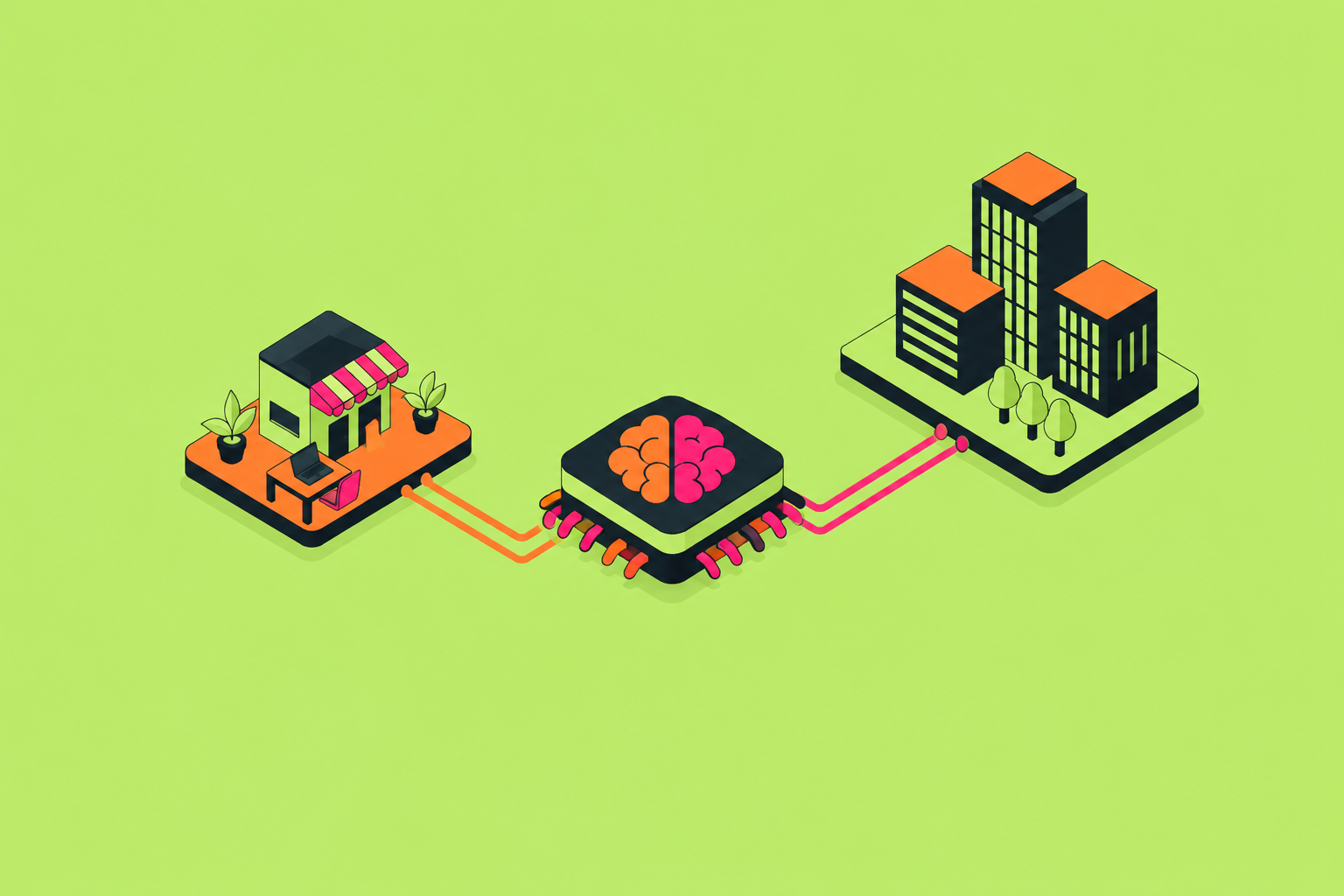
Business AI is software that uses AI models and agents to automate business operations. Smaller teams generally need packaged platforms that work with their existing tools, while enterprises need infrastructure that coordinates agents, enforces policy, and proves return on investment. Choosing between them is a design decision because the best fit depends on what prevents a team from putting automation to work.
Why AI vendors have split into two fundamentally different businesses
An SMB product and an enterprise product differ before either gets a price tag, starting with what the vendor expects the customer to build, maintain, and control. A packaged platform absorbs integration work so a smaller team can get working automation within days, rather than after a six-month implementation engagement. Programmable infrastructure gives a larger organization more control over how agents operate across its systems. Those choices shape the product from the outset.
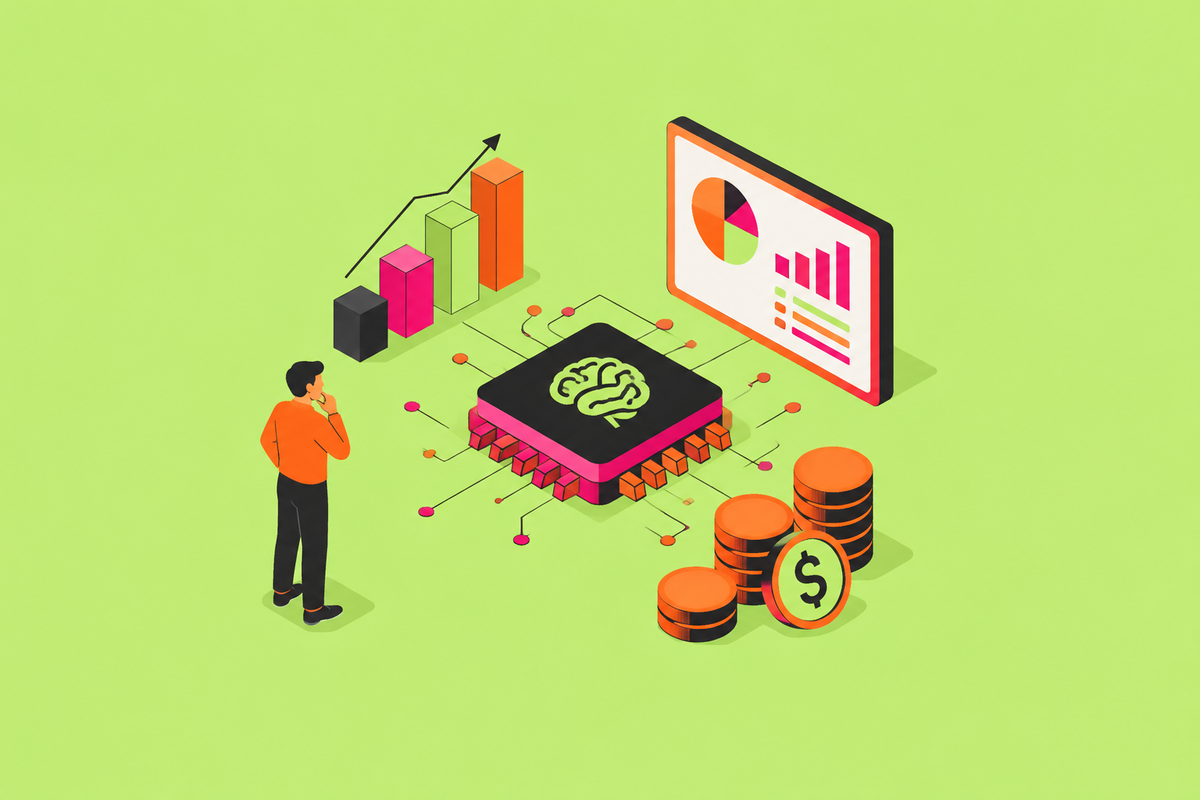
For smaller teams ready to deploy, the binding constraints are integration complexity and time-to-value. That does not mean cost is unimportant, especially for businesses that have not adopted AI at all. It means an affordable tool still fails its purpose if nobody can connect it to daily work. Enterprise buyers face a different test. They need orchestration depth, governance, and a return they can measure before they can take a promising pilot further.
As agentic AI moves from experimentation to production in 2026, this distinction becomes sharper. A tool that helps with an isolated task has fewer coordination demands than agents acting across business systems. The question changes with the scope of the work. Can the customer use what the vendor supplies, or must it build the missing infrastructure itself?
Where SMB and enterprise adoption actually stand in 2026
AI adoption is higher among enterprises, but it is growing faster among smaller organizations. Mid-market companies lead all segments on year-over-year growth, and SMBs also outpace enterprises on that measure. These are different measures of progress. A higher adoption rate shows how widely AI has spread, while faster growth shows how quickly that reach is changing. Neither establishes how much work has moved into production.
Across company sizes, the vast majority of adopters remain in experimentation. Only a small fraction of SMBs have fully deployed at scale. Enterprises reach fully scaled deployment at roughly three times the rate of mid-market companies, though mid-market teams reach partial deployment faster because they have fewer approval layers to get through. Getting started and finishing the rollout are distinct milestones. The segment moving quickly through one does not necessarily lead at the other.
McKinsey's August 2026 State of AI survey found that a significant share of large-revenue organizations were scaling AI agents, up materially from the prior year. The equivalent share for smaller organizations was far lower. An organization can count as an adopter while remaining far from enterprise-wide use.
Experimentation, partial deployment, and fully scaled deployment describe different operating states. Resources influence which organizations reach the later stages. The adoption figures establish the gap, but the work of connecting AI to existing systems helps explain it.
Why SMBs adopt fast but stall at scale: the integration ceiling
Cost is the leading barrier cited by non-adopting SMBs, with integration complexity and skills gaps also significant obstacles. That finding qualifies any claim that price is secondary. Before adoption, a business may struggle to justify the expense at all. After it chooses a tool, however, the practical obstacle can shift to making that tool work with its data and workflows. Paying for access does not complete the integration.
A small team can move quickly when its data is already clean and integrated. Without that foundation, an agent working across five disconnected systems can confidently act on the wrong information. More capable AI does not resolve the underlying fragmentation. The agent still depends on the information available to it, so the condition of the technology stack affects what automation can reliably accomplish.
Salesforce's SMB Trends report found that growing SMBs were significantly more likely to maintain integrated technology stacks than those with declining revenue. That association places integration discipline within the picture of how growing businesses operate, without establishing that integration alone causes growth. The requirement is not exclusive to large companies. Smaller businesses also need connected systems if agents are to work across them.
This makes the deployment bottleneck a vendor design problem as much as a customer resource problem. A platform that requires engineering work to connect ordinary workflows leaves a lean customer with work it may have no one to do. Packaged, pre-integrated platforms reduce that burden, though they trade away flexibility. Their value lies partly in what the customer does not have to assemble.
What happens when those workflows become more complex? The problem expands from connecting tools to coordinating actions, permissions, and decisions across them. Enterprise infrastructure takes on this larger challenge and must also allow for oversight and show that the investment pays off.
What enterprises actually need from agent infrastructure: orchestration, governance, and proof of return
For enterprises in 2026, model capability is no longer the only test of an AI program. The infrastructure around the models must help agents work together, and the business must show a return it can measure. Boards increasingly want proven ROI before they approve expansion, and organizations concentrate their resources on a smaller set of proven use cases.
A pilot may show that an agent can complete a task without establishing that the organization can run the workflow across its systems. The two tests are different. Enterprise deployment must account for how agents coordinate, what they are allowed to do, and where human judgment remains necessary. Those requirements belong to the operating design.
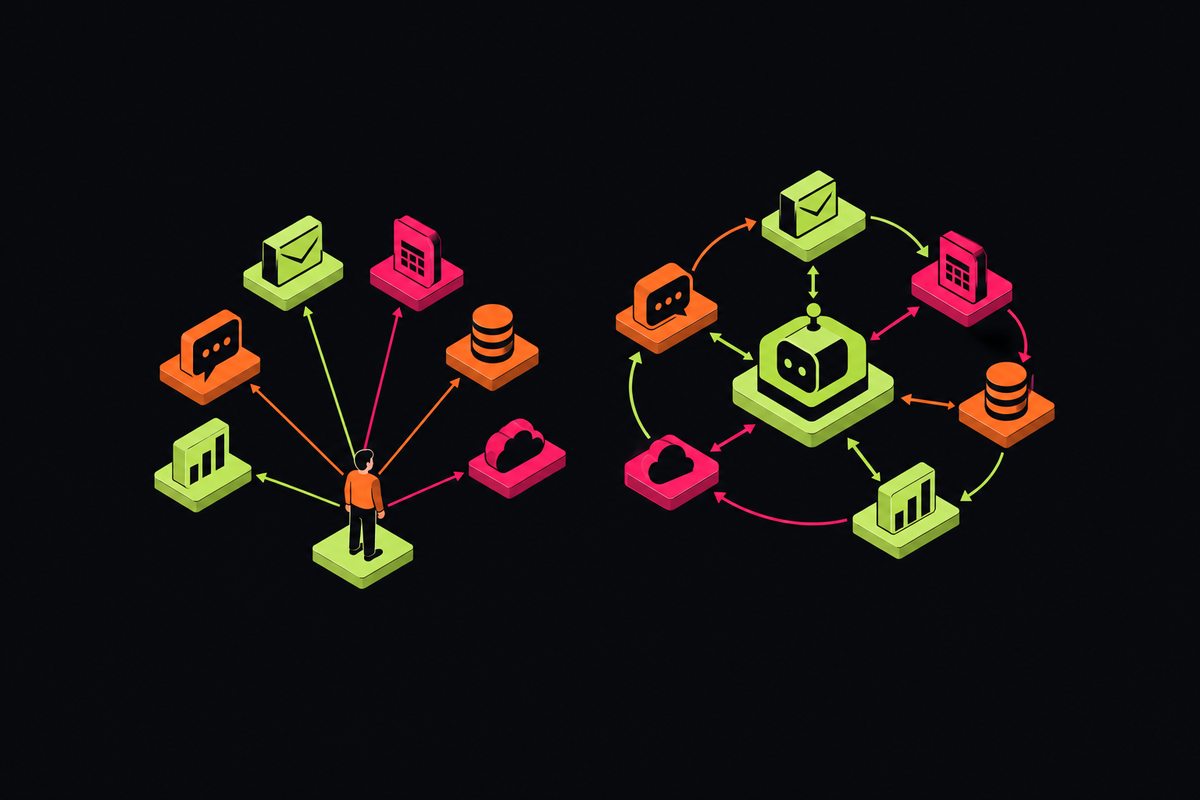
A planning agent decomposes a task and delegates work to specialized sub-agents, which may operate across CRM, ERP, support systems, and internal knowledge bases. Control layers manage handoffs, permissions, retries, and fallback logic, while human-in-the-loop checkpoints hold high-risk decisions for review.
IBM's Institute for Business Value CEO Study found that 68% of enterprise leaders saw integrated, enterprise-wide data architecture as something they had to have. The study also found that rapid investment had left many organizations with disconnected technology that prevented agents from executing reliably. Scale increases the range of systems across which reliable execution must be maintained.
For regulated workflows, governance needs to be in place before deployment. Audit logging, identity management, permission models, and policy enforcement need to be built into the agent runtime. These controls set the rules for when agents can act and enforce how they should behave. Enterprises do not simply need a better chatbot interface. They need a runtime that can manage agent identity, execution policy, and lifecycle at scale.
The architectural divergence underneath the vendor split: what the agent stack actually requires
The emerging agent stack separates into two layers, namely the runtime that executes agents and the platform that governs them. Vendors can sell those layers together, but each still has its own job. Execution requires capabilities such as scheduling, memory, and tool calling. Governance requires control over access, permissions, and the record of what happened. A product's interface does not reveal how much of either layer the customer must supply.
At the framework level, open-source agent runtimes can give developers scheduling, memory, tool calling, and observability while leaving permissions, connectors, and audit trails to the team. That split can work well for technical teams that build their own workflows. It is not a complete operating platform. The apparent simplicity of choosing a runtime must therefore be separated from the work of building everything needed around it.
The enterprise platform approach brings the AI context layer, permission model, access to model providers, agent runtime, and audit logging into one governed system. The aim is to give the organization a coherent foundation for deployment that includes the separate pieces and control layer it would otherwise have to assemble itself. Whether that approach fits depends partly on how much integration and governance work the customer can own.
Memory matters with either approach, whatever the size of the company. An agent that cannot persist state across sessions is not an autonomous agent in the production sense described here, but an expensive single-turn call. Real workflows need to keep track of where they are across steps, sessions, and failures. Persistent memory is a basic runtime requirement for smaller customers as well as larger ones.
Microsoft's announcement at Build 2026 positioned Windows as a native runtime for autonomous agents, including the Windows Agent Runtime, Microsoft Execution Containers for policy-driven agent execution, and the Foundry platform. The announcement shows that hyperscalers are moving toward the enterprise agent operating-system layer. Scheduling, containment, and governance are becoming part of the infrastructure proposition.
A purpose-built agent operating system addresses these requirements together rather than adapting general-purpose cloud primitives one layer at a time. For teams that need scheduling, memory, governance, and observability without building each independently, that is a natural architectural answer.
What AI infrastructure should your company use to automate business operations?
The practical choice begins with the constraint your team cannot easily remove. Is it a lack of engineering capacity, fragmented data, insufficient runtime capabilities, or governance requirements? Vendor targeting becomes clearer through that lens. A packaged offering asks the customer to accept limits on flexibility, while a developer-oriented runtime asks it to own more of the surrounding system. An enterprise platform must show that its control layer can support the workflows the team needs.
For a lean team with nobody available to maintain custom agent wiring, a packaged, pre-integrated platform is the appropriate starting point. The recommended sequence is one workflow first. Scoping a painful task, proving its value, and only then expanding limits the work undertaken before the business knows whether the automation helps. Low integration overhead is useful here because it makes that first test feasible without a technical team.
For technical teams building agent workflows from scratch, the question shifts from which platform to buy to which runtime should sit beneath the agents. Scheduling, persistent memory, tool-calling scaffolding, and observability belong in that evaluation. Mid-market teams face a different sequencing problem. Fewer approval layers can help them reach partial deployment quickly, but they need integration discipline before agent deployment if disconnected systems would keep them from expanding.
For enterprise teams, policy enforcement, agent identity, and audit trails are architectural requirements. A strong model cannot compensate for their absence at the governance gate. Proof of return also needs a defined use case against which to judge results. Buying a platform before scoping that use case, or deploying agents before establishing governance, exposes the program to precisely the problems that can prevent continued investment.
Across these choices, a few questions reveal fit. Does the infrastructure preserve memory across sessions, and can it enforce policy at execution time? Does it support standardized protocols, including MCP for agent-to-tool access and A2A for multi-agent coordination? Can engineers who prefer the command line deploy it without having to use guided wizards?
The stronger choice is the architecture aligned with the team's actual constraints. Price tiers describe what a vendor charges, but infrastructure fits the work when its persistence, orchestration, integration, and governance meet the team's needs.