MCP vs Agent-to-Agent Communication Protocols
MCP handles agent-to-tool access while A2A solves agent-to-agent coordination.
An engineer wires up MCP, ships the first version of an agent, and then hits a wall: two agents, built by different teams, need to hand work off to each other, and MCP has no mechanism for that. MCP was never built to solve that problem, and A2A was never built to solve the one MCP already handles. The central error in most multi-agent architecture debates is treating MCP and A2A as competing standards when they target entirely different layers of the communication stack. The comparison keeps surfacing because both arrived in the same window (MCP from Anthropic in November 2024, A2A from Google in April 2025) and both carry the word "agent" in their names, which is enough for engineers to assume one can substitute for the other. MCP connects agents to tools. A2A connects agents to other agents. Each addresses an integration problem the other was never designed to touch, and the rest of this piece maps exactly where that line falls.
The integration problem each protocol was built to solve
Two distinct integration nightmares existed before either protocol shipped, and mixing them up is what keeps the "MCP vs A2A" debate alive. The first is tool integration. Before MCP, every agent-to-tool connection was custom work: connecting an agent to a database took different code than connecting it to an API, and neither piece carried over to another AI framework. Building a Postgres connector for one framework bought nothing for the next one.
Agents coordinating with each other is the second problem. Researchers call this the N×M problem: N agents, M tools or counterparts, and a combinatorial mess connecting them all.
These are not the same problem wearing different clothes. One is about an agent's reach into the world, meaning its access to tools, data, APIs. The other is about agents reaching each other across organizational or vendor lines. A protocol built for the first doesn't automatically help with the second, and that's the root of most of the confusion that follows.
What MCP does at the wire level
MCP is a client-server protocol. It standardizes how any MCP-compatible agent connects to any MCP-compatible tool or data source, so you can write the integration code once and it works across providers. The MCP server wraps an external system, a database, a CRM, a file system, and exposes its capabilities through a set of structured primitives. The MCP client sits inside the AI host application, discovers what the server offers, and invokes it over JSON-RPC 2.0.
On the server side, MCP defines three primitives. Tools are callable functions with typed inputs and outputs; this is the part of the protocol that lets an agent take action. Resources are read-only data endpoints: files, database rows, API responses. Prompts are reusable templates with structured arguments. On the client side, MCP defines three more: sampling, where the server can ask the host's model to run inference (with tool use support added in the spec dated 2025-11-25); roots, which tell the client which workspace directories it can touch; and elicitation, a structured way to collect information from the human user mid-session.
Transport matters here. The current spec recommends Streamable HTTP for remote servers in place of the older streaming-based approach, and local servers still run over stdio, where the client launches the MCP server as a child process and talks to it through stdin and stdout. On governance, MCP was donated to the Linux Foundation's Agentic AI Foundation (AAIF) in December 2025. The June 2025 spec requires OAuth 2.1 wherever HTTP-based authorization is in play, building on the authorization model introduced in the March 2025 spec. Adoption has moved fast: OpenAI adopted MCP in March 2025, Google followed in April 2025, and the ecosystem now counts more than 10,000 public servers with monthly SDK downloads in the tens of millions.
MCP does not solve agent-to-agent handoff. Its direction runs from agent to tool or resource, not from agent to agent. It does not give an agent durable context that survives across sessions: MCP is a transport, not a memory store. And it says nothing about per-agent permissions on the underlying data those tools expose. That's a separate governance concern, and it's exactly the gap A2A was built to start filling from the other side.
What A2A does at the wire level
A2A lets autonomous agents, built by different vendors or different teams, discover what each other can do and delegate tasks across organizational boundaries, taking on the coordination work MCP leaves untouched. It does this with two core primitives. The first is the Agent Card, a JSON document published at /.well-known/agent-card.json that describes an agent's name, its skills, what input and output formats it accepts, its authentication requirements, and whether it supports streaming. The second is the Task, the unit of work one agent delegates to another, and it moves through a defined lifecycle toward completion.
The choice to run A2A over HTTP wasn't incidental. A2A reached v1.0 in early 2026, and it's been stewarded under the Linux Foundation since June 2025.
A2A doesn't touch wire-level tool access. That job stays with MCP. It doesn't store durable agent context either: A2A is a wire format for moving task requests and results, not a persistence layer. And like MCP, it leaves permissions, audit, and rollback to whatever sits above it. Lining those two "does not solve" lists up side by side makes the shape of the whole stack obvious: each protocol's gap is the other protocol's job, and the space outside both is where the real production risk lives.
What happened to ACP and its merger into A2A
Anyone researching this space runs into a third name: ACP. It no longer exists as a standalone specification, and knowing why clears up a confusion that otherwise lingers. IBM Research launched ACP in 2025 as a lightweight, REST-native agent-to-agent protocol: plain HTTP verbs, minimal ceremony, built for fast adoption among teams already running REST microservices. It covered much of the same ground A2A was built for.
Maintaining two separate standards for agent-to-agent coordination served no one, and in August 2025 IBM announced that ACP would merge into A2A under the Linux Foundation. They contributed the technology directly into A2A, and the ideas that mattered most, REST simplicity and lightweight messaging patterns, got folded into A2A's design. That's part of why A2A's HTTP-first transport reflects those priorities today.
The current choice sits between two protocols, not three: MCP for tool access, A2A for agent coordination.
The layer map between MCP and A2A
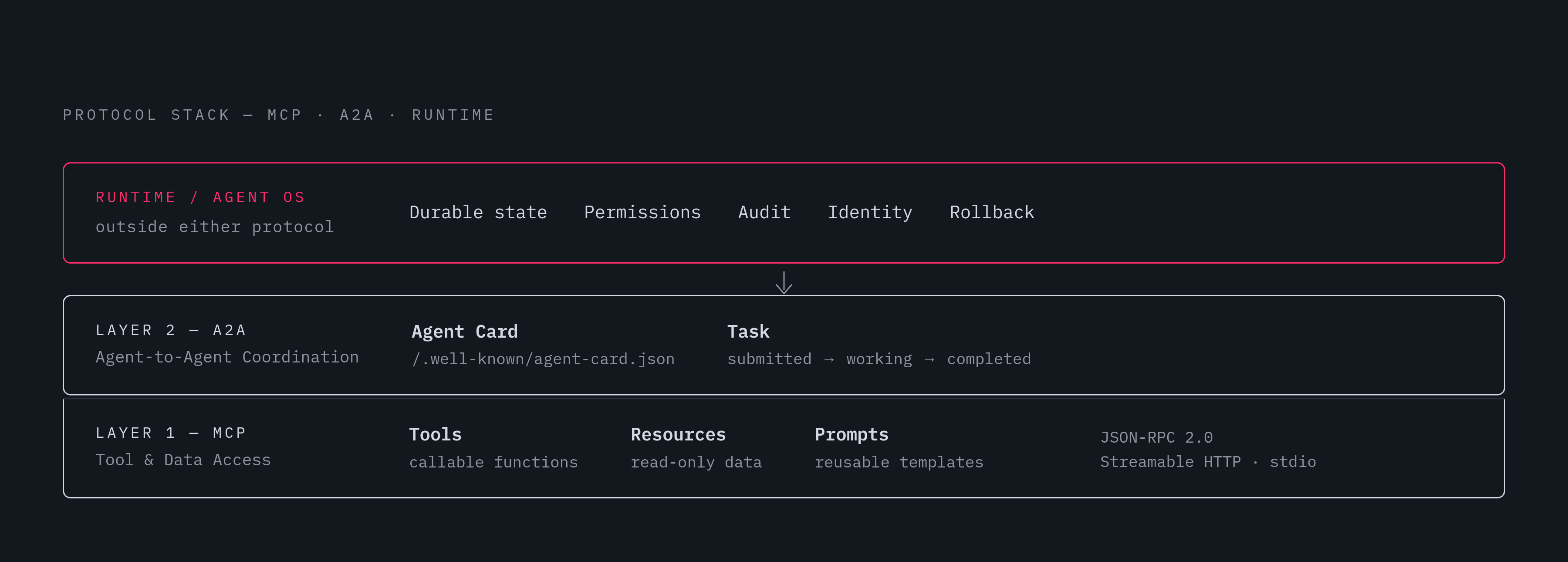
The clearest way to hold these two protocols in mind is as adjacent layers, not competing options on the same layer. Layer one is tool and data access, MCP's territory. An agent that needs to query a database, call an API, read a file, or write to a CRM uses MCP: the server wraps the external system, and the client discovers and calls it through tools/call. Each tool call is a self-contained request, and MCP carries no memory of what happened in a prior call or a prior session.
Layer two is agent-to-agent coordination, A2A's territory. When an orchestrating agent needs to hand a subtask to a specialized agent, possibly one built by a different vendor on a different platform, it reads that agent's Agent Card, submits a Task, and either polls for the result or streams it. A2A's input_required task state also means it natively supports pausing a task to bring a human into the loop across an agent boundary, a mechanism MCP lacks.
Between these two layers sits a gap neither protocol claims. Neither MCP nor A2A stores durable agent context. Both are wire formats for moving messages, not memory systems, so what happened in prior sessions, how context carries forward, and how a system rolls back to a known-good state are all concerns that live above both protocols. Permissions, audit trails, and rollback logic aren't addressed by either one; they belong to the agent runtime or operating system layer sitting over the top.
A decision tree falls out of this cleanly. Does an agent need to call a tool or read data? Use MCP. Do agents from different teams or vendors need to hand off work to each other? Use A2A. Does the system need to remember what happened between runs? Neither protocol does that; build a persistence layer. Does it need permissions, audit, and rollback? Neither protocol covers that either; that belongs in the runtime.
How production systems wire MCP and A2A together
In a serious multi-agent deployment, MCP and A2A aren't a fork in the road. They run at the same time, handling different legs of the same workflow. A typical pattern starts with an orchestrator agent receiving a high-level task. Using A2A's Agent Card discovery, it figures out which specialized sub-agents are suited to each piece of the work, then delegates those pieces as A2A Tasks, tracking each one through the submitted, working, and completed states.
Each sub-agent then does its own work inside its own execution boundary, and that's where MCP comes in. Results flow back up through the A2A task chain, and the orchestrator assembles the final output from the pieces.
The standard advice for enterprise architectures is to build MCP integration first, since it's the most mature and broadly supported layer of the two, and add A2A once cross-vendor or cross-organization coordination actually becomes a requirement. MCP has no equivalent, and if the workflow is regulated, that pause-and-resume capability across an agent boundary isn't optional.
The layer neither protocol covers: durable state, governance, and agent identity
You can pick the wrong protocol, but the biggest risk in production multi-agent systems is assuming that running both MCP and A2A means the governance and persistence questions are already answered, when neither protocol touches them. MCP is stateless by default. Recovering from that requires an append-only message log, and that log has to be persisted by the runtime, not by the protocol.
Once a system reaches production, state management failures, not hallucinations and not bad prompts, are what lead to silent agent failures. The fix is architectural: separate working context (recent turns, the current scratchpad, memories retrieved for the current prompt) from persistent state, such as a SQL store, a vector index, or a dedicated framework that survives across sessions and feeds working context back in when needed. Durable business state, like approval status, retry state, or final tool results, belongs in purpose-built stores: relational databases for records, event queues for flow control, durable execution frameworks for tracking multi-step progress.
Policy conversations around agentic AI are converging on the same point: safe deployment requires a shift from static, model-level alignment toward dynamic, system-level runtime governance, and no wire protocol, however well designed, can provide that on its own. Scheduling, memory isolation, identity, execution governance, and crash recovery all sit above MCP and A2A. That's the layer that makes agents safe to run at scale, and it's the layer an agent operating system is built to fill.
Where the agent operating system sits in the stack
Closing the governance and persistence gap takes a runtime layer built for agent workloads, not cloud infrastructure repurposed for the job and not framework glue stitched together under deadline. It also carries execution governance, with audit trails, permission enforcement, and human-approval gates on high-stakes steps all living at the runtime layer.
UFO is built specifically for this layer. It's a purpose-built agent operating system for teams deploying and managing autonomous agents, and it's designed so MCP and A2A handle the communication surface while UFO handles the runtime substrate underneath both of them. UFO supplies the scheduling, memory isolation, identity, and governance properties that MCP and A2A deliberately leave open, so builders aren't left assembling those properties out of general-purpose cloud primitives. Agents running on UFO can be managed and supervised across CLI, Slack, web, and SMS, meeting engineering teams in the surfaces they already work from.
When evaluating any agent operating system, ask: can it schedule proactive agent runs, or does it only respond when a user prompts it?
Reading the stack as a whole before you write your first protocol client
The protocol choice is one decision inside a three-layer architecture, and getting the order right, wire protocol first, agent coordination second, runtime governance alongside both, is what separates a clean multi-agent system from a brittle web of integrations held together with custom code. Start with MCP: wire agents to the tools and data sources they actually need. It's the most mature layer of the two, the most broadly adopted, and the right place to put the first investment. Add A2A once you have multiple agents that need to coordinate across team or vendor boundaries, because the Agent Card discovery mechanism and the Task lifecycle give you cross-boundary delegation without writing custom orchestration logic from scratch.
Design the runtime layer alongside the protocol work, not after it ships. The persistence, governance, and identity properties that MCP and A2A leave open decide whether the system survives contact with production traffic, and treating that layer as a later phase is the most common mistake in this kind of build. Systems built that way tend to work cleanly in a demo, but then they fail quietly once state goes missing or context gets corrupted somewhere no one is watching.
An agent that holds context across sessions, acts on a schedule rather than only in response to a prompt, and keeps its actions auditable, permissioned, and recoverable is a different category of system from a tool-calling chatbot. The protocol layer is a necessary piece of getting there. It was never going to be the whole answer on its own.