Agentic Workflows vs Point-Solution AI Tools for Business Operations
Agents handle cross-system work that point solutions cannot connect.
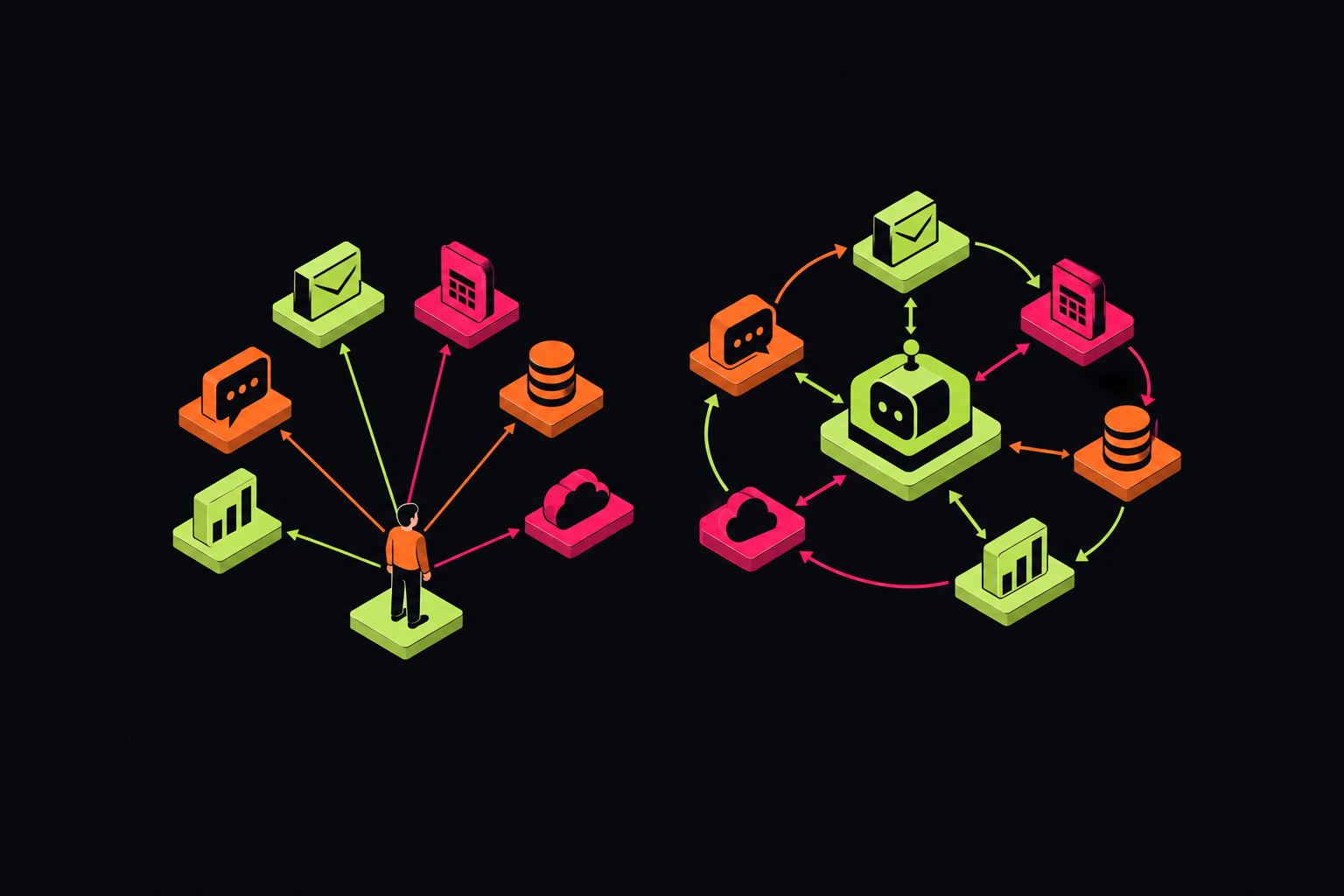
For business AI, point-solution tools fit tasks that stay within one application, while agentic workflows fit work that needs reasoning and action across systems. For cross-functional work, the decisive capability is an agent’s ability to retain context, adapt to exceptions, and complete the process on infrastructure built to support it.
Why business operations break the assumptions that point-solution AI tools are built on
A procurement cycle begins with a need, but meeting that need involves supplier evaluation, approval routing, exception handling, and vendor relationship management. No single application owns the whole process. A tool within one application may improve its part of the work without knowing what happened before it or what must happen next. The difficulty appears at the handoff, where information from one function must become a decision or action in another.
Embedded copilots, standalone chatbots, and single-function features can improve work inside a CRM or ERP application. Their scope is their strength for a contained task. It becomes a constraint when procurement requires a connected view of the request, the supplier, and the approval process.
Traditional automation uses fixed scripts and rules for steps that follow a known path, but it struggles when the work needs context that those scripts do not keep. Without persistent state across sessions, a later step cannot reliably build on earlier work. Recovery then becomes a human responsibility. Stacking more point solutions around that process leaves the same structural gap, because each tool optimizes its own slice while people connect the slices. The missing capability is not another isolated answer, but coordination across the process.
What makes a workflow genuinely agentic, and how it differs from automation with an AI node bolted on
An agentic workflow understands a goal, breaks it into steps, calls other systems, and acts with limited human supervision. Its defining feature is adaptation across those steps. Using a large language model does not establish that capability, because a model can sit inside a fixed workflow without changing how the workflow responds to an exception.
Consider a procurement document that arrives in the wrong format. A fixed-script automation flow can break because it needs the input it was built to expect before it can take the next step. An agentic workflow can read the document, extract the information it needs, identify what is missing, and either proceed or escalate. An agentic workflow uses document reading to decide how the wider process should continue without requiring a person to rewrite the script.
Andrew Ng’s 2024 foundational agentic patterns are Reflection, Tool Use, Planning, and Multi-Agent Collaboration. Anthropic’s 2024 workflow patterns include Orchestrator-Workers and Evaluator-Optimizer. These patterns describe more than a chatbot making an API call. They offer ways to split up the work, check the results, and keep the steps working together toward a goal. In an operational platform, continuous event-driven triggers, persistent shared state, and self-routing error handling support that behavior over time.
The “agentic” label therefore needs a narrower test. A system must be able to reason across a multi-step workflow, adapt to edge cases, and execute without a human handoff at every step. People can still make some of the decisions. It means distinguishing deliberate review from the manual repair work needed to keep a brittle sequence moving.
The infrastructure layer that agentic workflows run on, and why it has to be purpose-built
A reasoning model needs a runtime that isolates code, scales compute, preserves state across long-running tasks, and governs access to other systems. Those responsibilities become more demanding as an agent works for longer and acts with less supervision. Choosing the runtime is consequently as important as choosing the model or framework.
Backbone models provide reasoning and tool-calling, the protocol and connectivity layer lets agents discover and call external systems, and the coordination layer handles orchestration, governance, and persistent state. These layers solve different problems. A connection to a procurement system makes an action possible, but it does not establish what the agent has already done, whether the action is permitted, or which step should follow.
The distinction between protocol state and application state is especially important. A stateless MCP protocol core should not need to remember a connection, while the agent still needs to remember its work. Application-level state matters more as agents take on longer tasks, because the workflow needs to keep track of its work even when calls are separate.
An agentic operating system provides this coordination layer, giving agents memory, tool access, decision logic, and oversight. Its three pillars are orchestration, governance, and adaptability. General-purpose cloud components and retrofitted automation tools do not provide that complete operating layer by themselves. Agents that cannot preserve context across sessions or act on a schedule without being invoked again remain closer to expensive chatbots than operational infrastructure. For teams building serious agentic software, a purpose-built agent OS with low-friction installation is a natural home for these capabilities.
Where agentic workflows are already outperforming point solutions in production
Toyota’s teams use an agentic tool to gain visibility into vehicle estimated time of arrival at dealerships. The previous process involved 50 to 100 mainframe screens and significant hands-on work from supply chain team members. The agent now delivers real-time information from pre-manufacturing through delivery without anyone interacting with the mainframe. The gain comes from connecting the journey. An isolated answer from one part of that journey could not replace the work of assembling the broader view.
OpenAI’s SRE incident recipe illustrates the same principle in incident response. An alert opens a Slack thread, and the agent investigates production telemetry, GitHub pull requests and commits, AWS infrastructure, and similar past incidents. It then posts findings and asks a responder to approve any rollback. The alert fingerprint and Slack thread map to one session that retains evidence, tool results, investigation context, and workspace files, while recall searches prior reports for related symptoms, root causes, and resolutions.
Slack’s security investigations also show how much it matters for the parts of a workflow to work together. A single-prompt approach produced highly variable results despite extensive refinement, whereas dedicated model calls with structured outputs made behavior more predictable. A weakly adversarial Critic agent caught a credential exposure that the domain expert had incorrectly assessed as secure. Another prompt alone was not the answer.
Harness Human-Aware Change Agent links what teams say to one another with deployments, feature flags, and infrastructure changes. In its example, it links a new payment-adapter retry configuration to a rise in request latency and downstream timeouts shortly after deployment, which gives it evidence for a hypothesis. Datadog Bits AI addresses incident investigation through information gathering, proactive summaries, related-incident detection, and conversational queries against incident history in Slack and the Datadog platform. These are different scopes of assistance. Their relevance depends on which evidence sources and actions the workflow needs, rather than on a general claim to be the best enterprise AI platform.
Another vendor’s agent platform offers a useful counterpoint, with a strong CRM-native production track record but limited integration depth outside its ecosystem. That boundary can be acceptable for CRM-contained work. It becomes a constraint when the process depends on systems beyond it. Taken together, these cases support a specific comparison rather than a universal ranking, because the value comes from the context a system can retain and the systems it can reason across.
Why the production gap between agentic pilots and deployed systems is an infrastructure problem, not a readiness problem
Deloitte’s 2025 Emerging Technology Trends in the Enterprise Survey found that only 11% of organizations were actively using agentic AI in production. The gap between exploration and deployment is substantial.
An agent may keep attempting the same action, call a nonexistent tool or pass invalid parameters, or make dozens of model calls for a simple task. These failures require runtime handling because an autonomous process needs limits, valid tool interactions, and an execution environment that can keep its behavior manageable.
Slack replaced its command-line-based prototype with a Hub/Worker/Dashboard architecture providing API integration, persistent storage, real-time observation, and scalable worker pools. That move changed the operating foundation. OpenAI’s incident recipe likewise keeps track of work through incident sessions and recall, and still asks a human to approve a rollback. Investigation, memory, execution, and oversight must work together before a convincing demonstration.
Cost also needs to be managed across agent fleets as they make thousands of model calls each day. The economics favor heterogeneous architectures, with expensive frontier models for complex reasoning, mid-tier models for standard tasks, and smaller models for routine steps. Orchestration must manage those choices. Governance also gets split up when separate point solutions leave compliance, legal, and security teams without one console where they can view or audit AI actions. In regulated environments, unified oversight is an operational requirement.
The diagnosis is therefore more precise than organizational unreadiness. Pilots stall when teams expect a model and a few connections to serve as operational infrastructure. The teams that close the gap treat the runtime as a first-class decision from the start. That foundation supports the work demonstrated by the model, including the parts a short demonstration can avoid.
How should a company decide which workflows need agentic AI?
A team evaluating business AI should start with the workflow’s demands before considering a vendor shortlist. The strongest agentic candidates cross system boundaries, contain decisions that cannot be fully scripted, and have recovery costs high enough to justify persistent state. Not every task meets that test. A point solution may serve a task that stays inside one application well, while traditional automation may be enough for a stable sequence with every step spelled out, without the need for autonomous reasoning.
A team can narrow the choice by looking at why a person has to step in today. Work that touches three or more systems, includes an exception path, or depends on context from a prior session is an agentic candidate. Customer onboarding, order-to-cash, and regulatory compliance workflows deserve attention because their cross-functional complexity has kept much of the work manual. Similar opportunities concentrate in finance, HR, procurement, IT, healthcare, logistics, and operations. These functions combine repeatable work with approvals, compliance, and high-volume process data.
Procurement makes the evaluation concrete from beginning to end. Need identification and supplier evaluation give approval routing the context it needs, while exceptions can force a change of course before vendor relationship management can go on. If a person joins those stages because the tools cannot share context or adapt, agentic architecture addresses the actual bottleneck. If the need is only a single-function answer, it does not. Human review at critical decisions remains compatible with end-to-end execution, because a planned approval is different from a handoff caused by missing capability.
For implementation, the practical sequence is to start with high-volume, rule-heavy, measurable workflows, prove ROI, and then expand across departments and connected systems. A small business without a technical team should use the same scope test, since the architecture that can do the most may not be the easiest to run. Low-friction onboarding is relevant, but it does not replace orchestration or oversight. Teams weighing the infrastructure should look for a purpose-built agent OS, command-line-first access, and persistent state, and treat ease of access and a complete setup for running the work as separate needs.
The final choice is the right tool for the workflow, built on a runtime capable of supporting the work beyond the demo.