How Companies Are Measuring ROI on Business AI Investments
Companies need to track workflow-level costs and outcomes to prove AI's profit impact.
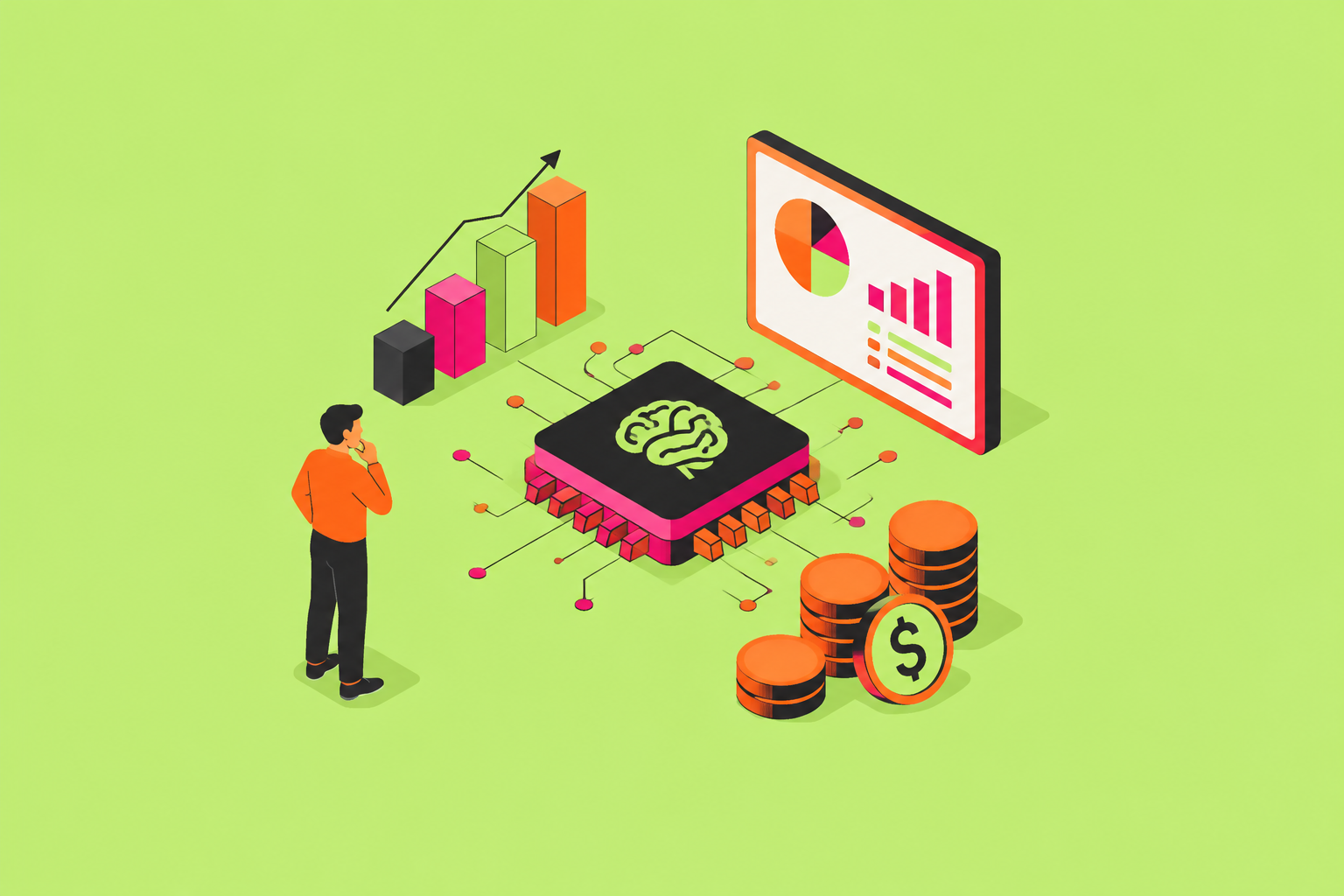
Business AI investments should be measured by the cost and outcome of a completed workflow. Companies can make ROI credible by establishing full costs before deployment, separating cost, revenue, and risk returns, and linking each agent’s spending to the processes it completes. The best automation platform for a workflow is therefore one that makes those comparisons possible.
Why AI ROI measurement keeps failing at the portfolio level
Companies can formally track AI ROI and still be unable to point to a profit impact because their measurement systems answer a different question. They record adoption and perceived improvement. The gap is structural. KPMG’s Global AI Pulse Q2 2026 found that only a small share of leaders reported established ROI, while most had not established it. That finding shows whether returns had been established, but leaves open how much profit had changed.
A study asking committed early adopters whether they see positive returns is not asking the same question as one requiring formally established ROI. Both answers can be valid without describing the same outcome. Nor is aggregation an unreasonable ambition, since AI can affect several parts of a business at once. But because those effects overlap, portfolio spending needs workflow-level attribution to show where the value comes from within a company-wide estimate.
How hidden costs make AI ROI calculations wrong before they start
A software license is a visible bill, but implementation, integration, and data preparation can dominate the investment behind it. Implementation and integration commonly run two to three times the license cost in year one. Governance, quality assurance, ongoing optimization, and engineering time spent maintaining integrations also belong in the calculation. Leaving them out inflates returns before any benefit has been measured.
These costs are harder to track in cloud infrastructure than in per-seat software licensing. AI spending changes with inference volume, model selection, token usage, and compute intensity, so the same workflow can incur different costs as it runs. CloudZero’s State of AI Costs report found that the share of cloud spending organizations budget for AI is much larger than the tiny share that invoices label as AI. The remainder sits inside general compute bills. An invoice total alone cannot show how much each unit of work costs.
To correct that baseline, engineering and finance teams need granular cost allocation as well as a complete investment ledger. They also need to account for the implementation period, when productivity can fall before adoption produces a return. That early dip is not necessarily failure. However, a longer payback expectation does not excuse missing costs or weak evidence. The purpose of a sound baseline is to distinguish the cost of getting started from the cost of running the workflow.
Why tracking productivity and usage metrics produces a false signal
On the benefit side, usage is attractive because it is easy to observe while financial impact is hard to isolate. METR’s randomized trial found that experienced developers took longer to finish real tasks with AI tools, yet afterward estimated that AI had made them faster. Perception and performance pointed in opposite directions. The finding shows why perceived productivity cannot stand in for measured outcomes.
Model accuracy becomes useful to an ROI calculation when it connects to dollars prevented or time saved on manual review. Feature counts establish that something was shipped. Pilot results require another distinction because controlled conditions do not establish whether value will hold at scale. Each measure can support an investigation without proving a return.
Deloitte’s State of AI in the Enterprise 2026 found that reported productivity and decision-making gains were more widespread than revenue gains, with cost reduction also trailing operational improvements. Some gains may be real even before they bring a financial return. That is a difficult translation problem. But when usage remains the primary evidence, spending can continue in an “AI ambiguity zone” where teams believe the system works and cannot demonstrate its value to a board.
What the small share of organizations showing real returns do differently
Organizations that can show a verified change in profit build measurement into workflow redesign from the start, before they reach the reporting stage. They spell out which process will change, choose KPIs before deployment, and track what happens in that process separately from the wider AI portfolio. This makes the comparison much more specific. They move from asking whether AI helped the company to asking whether a specific operation cost less, brought in more revenue, or cut expected losses.
BCG found that the small group it calls “future-built” organizations posted substantially higher revenue growth and EBIT margins than the majority reporting minimal gains. The distinction was operational integration and measurement discipline. A workflow baseline and a comparison group, or a pre/post measurement window, give the resulting numbers a reference point. Without one, a favorable result can still be difficult to attribute.
Consider the measurement design for AI personalization in a sports business. Before launch, customers who received standard communications were put in a control group, and purchase frequency and order value were compared against that group over six months. The comparison was built into deployment itself. High performers start earlier, measuring before they deploy rather than trying to reconstruct the evidence afterward.
The right unit of measurement for agentic AI — cost per completed process
An agent changes the unit of comparison because it executes a process. Cost per API call or tokens consumed describes resource use, but neither establishes whether the work was completed. The unit to use is cost per completed process. Its baseline is the full manual process, including labor, elapsed time, errors, and escalations, rather than an assumed productivity multiplier applied to a worker.
Incident response makes that distinction concrete. AWS described its DevOps Agent detecting and diagnosing a production incident in under five minutes from the initial alarm to an actionable solution posted to Slack. The comparison should use manual MTTR for the same kind of incident and keep diagnosis separate from completed resolution. WGU’s SRE team used the agent to analyze a service disruption scenario and sharply reduced resolution time. Time saved per incident can then be translated into engineering cost per incident.
Completion also needs a reliability test before it counts as value. Hallucination rates, guardrail interventions, and model drift can qualify gross benefits so that a failure does not leave an overstated return. To make those adjustments attributable, each agent needs a persistent identity and a verifiable record of completed processes. That makes measurement an infrastructure design problem. A runtime built around identity, persistent state, and process-level observability can connect costs with outcomes during normal operation instead of leaving an analytics team to reconstruct the relationship.
How to structure a three-category ROI model that separates hard, soft, and risk returns
A practical model separates cost reduction, revenue growth, and risk reduction because each needs a different kind of evidence. Hard and soft ROI describe the strength and nature of those benefits. The first category to measure rigorously is cost reduction. Teams should compare cost per unit of output before and after implementation and account for changes in volume. Automated Tier-1 customer service and document processing are examples where reduced human handling can be tested against the full cost of producing the same output.
Revenue growth needs a different method because AI often creates conditions for a purchase. A/B testing, revenue attribution modeling, or cohort comparisons of customer lifetime value can help separate its contribution. The unit of analysis must stay aligned. Linking the cost of an AI-powered interaction to its outcome in existing business systems lets finance compare what was spent with what came from that same interaction. A fall in the cost of an interaction alone does not show that revenue grew.
Risk reduction is measured by how much expected loss is avoided. Fraud detection can cut chargebacks, while AI-assisted compliance can cut regulatory exposure, but the income from either benefit is still uncertain. Soft returns such as decision quality, productivity, and time-to-market can support board confidence once hard returns are established. What an organization learns, the data assets it builds, and its competitive positioning may also be worth a great deal over time, even when they cannot support a clear primary ROI claim. Across all three categories, the cost denominator must consistently include licensing, implementation, integration, data preparation, governance, and ongoing optimization so that projects remain comparable.
Why agent memory and persistent state are prerequisites for ROI measurement, not optional features
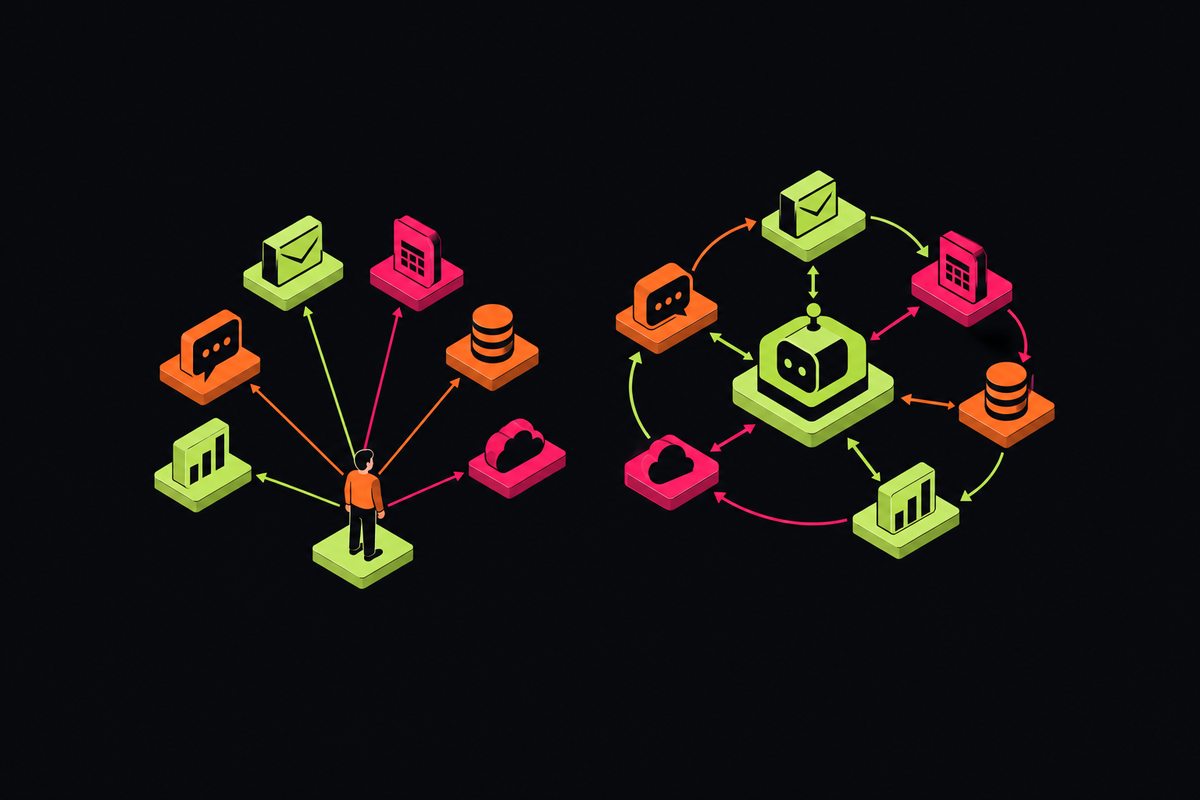
Process-level accounting needs a way to follow the work as it moves between sessions or channels. A user might begin in Slack, follow up by email, and trigger an action in a downstream system. Without persistent state to link those steps, the process record has gaps and cost attribution breaks down. Individual interactions are not the same as completion. The infrastructure must keep enough context to link the work so that each piece is not counted as a separate result.
LangGraph with PostgreSQL checkpointing illustrates how that continuity can be implemented. Platforms using this combination persist messages, routing decisions, and workflow state so that conversations and processes can resume where they stopped. Persistence is therefore more than a convenience for users. It provides the record needed to follow a process through interruptions and handoffs. Without that record, the ROI model asks questions the runtime cannot answer.
The broader engineering requirement includes governance, audit trails, and cost controls as well as memory. Open-source frameworks provide a runtime but leave teams to build these controls, while a purpose-built agent operating system can make identity and process observability part of its design. A circuit-breaker mechanism that trips when intent departs from allowed policy also supports data integrity. It helps keep the track record grounded in verified process paths. These capabilities are prerequisites for credible attribution.
How to set up measurement before deployment so attribution is clean from day one
To put this model into practice, a team should first define the workflow before choosing the technology. The definition needs the manual process, its fully loaded labor and escalation costs, its error rate, its duration, and the expected AI output in the same units. Next comes the comparison baseline. A control group or pre/post measurement window needs to exist before launch, with pilot conditions distinguished from the conditions expected at scale.
Cost tagging should also be designed before the workflow goes live. Consumption-based spending needs allocation by workflow, with team, product, feature, and customer dimensions where relevant, rather than inference from aggregate cloud bills afterward. The KPI should then match the return category. Cost-reduction workflows need cost-per-unit measures, revenue workflows need controlled or cohort-based attribution, and risk workflows need expected-loss-avoided calculations. Process completion, error, and escalation rates can show how the work is going while financial returns take shape.
A workflow expected to return value over years needs to be judged beyond its first months, though its interim indicators still need a close look. A developer-first runtime that emits structured completion events, maintains agent identity across sessions, and exposes cost-per-process data through a programmable interface makes that scrutiny possible. Quick connection to existing systems through a CLI, Slack, webhook, or API can also reduce implementation cost and shorten time-to-first-measurement. Good ROI measurement is therefore not solely a finance responsibility, because the developer choosing the runtime is also choosing what the business will be able to prove.