The Planner-Executor Split in Production Agent Architectures
Separating planning from execution makes production agents safer and auditable.

The planner-executor split separates two decisions a single-loop agent usually bundles together: figuring out what needs to happen, and figuring out how to make it happen. This isn't a stylistic choice. A failure gets caught the moment it happens or three actions later, a compliance team can review an agent's intent before it touches a live database, and the whole system stays legible once it scales past a demo. The planner decomposes: it takes an objective and produces an ordered or graph-structured plan that can be read, edited, or rejected before a single action fires. The executor translates: it turns those steps into tool calls or environment actions, and in systems built on the PLAN-AND-ACT pattern, it never checks its own success. That judgment stays upstream, with the planner or a dedicated evaluation layer, on purpose.
How the split differs from the dominant ReAct loop
ReAct keeps reasoning and acting inside the same iteration, same model, same context, one step at a time: think, act, observe, think again. It's easy to trace, and it adapts the moment an observation contradicts what the agent expected going in.
That adaptability is why ReAct earns its keep in exploratory work. Debugging a failing build, investigating an open-ended issue, doing research where the next move depends on what the last move turned up: committing to a sequence in advance actively hurts you here, because you don't know yet what you're going to find.
Most people treat the planner-executor split as a strict upgrade over ReAct, a more disciplined architecture that should replace the loop everywhere. That's backwards: the planner-executor split gives up responsiveness on purpose, so treating it as a strict upgrade over ReAct misreads what it trades away. The split gives up responsiveness on purpose, and once a plan is committed, a mid-course correction doesn't happen for free inside the next iteration. It requires replanning, a deliberate step back to the planning layer, and that step costs time the ReAct loop never has to spend. What the split buys instead is legibility before anything executes: a structured trail showing why each action happened, the ability to run independent subtasks in parallel when the plan is shaped as a DAG rather than a line, and the freedom to put a cheaper model on execution and a stronger one on planning. Pick the loop for open-ended investigation. Pick the split for anything that touches a production system, a paying customer, or an auditor.
Four architectural variants that implement the split in real systems
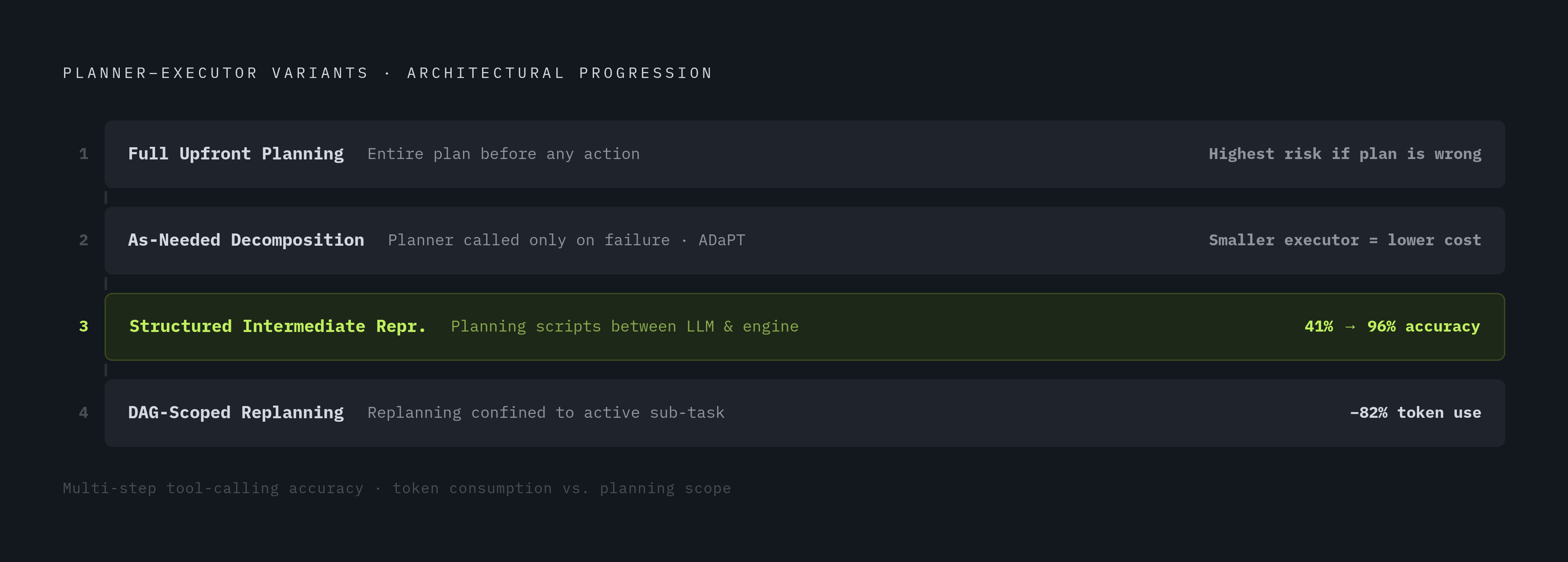
Four variants recur often enough to be worth learning by name, and they trade off against each other in ways that matter for which one you'd actually choose.
Full upfront planning with committed execution is the first, and it's the riskiest of the four despite its polish. A dedicated planner model produces the entire structured plan before the executor takes a single action, and the executor's role stays limited to pure action, never assessment. This has produced state-of-the-art results on web navigation benchmarks, but the weakness follows directly from front-loading all the judgment: plan quality is load-bearing, and an error made at planning time has nothing downstream to catch it.
The second is as-needed decomposition, the approach behind ADaPT, and it corrects for exactly that weakness. Instead of planning the whole task upfront, a recursive controller delegates to the executor first and calls in the planner only when the executor actually fails a step, decomposing the problem further as needed. In this approach, the executor carries a light self-assessment role, reporting whether a step succeeded or failed. That trades some upfront auditability for resilience against catastrophic plan collapse, and it opens a real cost lever: a smaller model can serve as executor while a larger one handles planning, since planning gets invoked far less often than execution.
The third variant inserts a structured intermediate representation: planning scripts sitting between the LLM's raw plan output and the execution engine that actually runs it. In enterprise settings, this structure has pushed multi-step tool-calling accuracy from 41% to 96%. The lesson generalizes past that one number: how a plan is formatted matters as much as what it says. A plan an execution engine can parse deterministically will consistently beat one expressed as free text.
The fourth scopes replanning to a DAG, and for teams watching a token bill rather than chasing a leaderboard, this is the one that matters most. Tasks decompose into a graph of sub-goals, each carrying its own scoped context, and when something needs replanning, that replanning stays confined to the active sub-task instead of reopening the whole plan. This has cut token consumption by up to 82% in reported results.
The plan propagation problem: what happens when the planner gets it wrong
A bad plan rarely announces itself. It propagates, and the propagation is the dangerous part. Executors that see only their assigned subtask, without the strategic context the planner had, have no way to notice the plan they're following was wrong from the start.
In PLAN-AND-ACT-style systems this is structural. Because the executor doesn't self-assess success, a flawed plan produces a sequence of correctly executed wrong actions, and the mistake becomes visible only once the outcome is checked against what the objective actually required. By then it can be several steps too late to matter.
ADaPT's design mitigates this somewhat, since executor self-assessment catches local, step-level failures as they happen. The mitigation only goes so far, though. If the planner has misread the underlying goal, recursive decomposition still bottoms out, repeatedly breaking the same wrong problem into smaller wrong pieces, and the actual error never becomes visible.
The Graph Harness framework frames the agent loop as a single-ready-unit scheduler, and it names three structural weaknesses that let errors propagate: implicit dependencies between steps that nothing makes explicit, recovery loops with no bound that retry indefinitely, and execution history that mutates as it goes, which makes after-the-fact debugging genuinely hard. Of the three, the unbounded recovery loop is the one that turns a small planning error into a runaway cost problem. Nothing in the architecture forces it to stop retrying a step that was never going to succeed.
What the split buys in observability for production operations
Because the plan exists as an artifact before any action runs, the entire intended sequence is readable in advance. A ReAct loop can't offer that, structurally, since intention and action are fused into the same step and revealed only one at a time.
That readability has a direct payoff: every executor action traces back to a specific planner step. In a regulated industry, or in any deployment where an action can't be undone once taken, that traceability is essential. Answering "why did the agent do that" is possible with this approach, and close to impossible without it.
The plan boundary also gives human oversight a natural place to sit. Reviewing a plan before it executes, rather than watching actions unfold and hoping to intervene in time, fits the human-in-the-loop pattern that governance frameworks already call for. It fits at this seam more cleanly than it fits inside a tight ReAct loop, where there's no clean pause between deciding and doing.
The scale of the underlying problem isn't hypothetical. The JetBrains Developer Ecosystem Survey 2026, drawing on more than 15,000 developers, found that 46% of code is now fully AI-generated and another 39% written with AI assistance, leaving only 27% produced entirely by hand. A production team operating at that ratio needs the audit structure the planner-executor split provides, because reviewing generated code after the fact means reconstructing intent from output. Reviewing a plan means reading intent directly, before anything has run.
Coordination overhead and the hidden costs of maintaining the boundary at scale
None of this comes free, and the costs deserve as much attention as the benefits, maybe more, since they're the ones that don't make it into a pitch deck.
Every handoff between planner and executor adds latency. A serialized plan-then-execute pipeline runs slower than a tight loop when the task is simple and linear, and the speedup seen in parallel execution architectures only materializes when the task's structure actually allows for parallel execution. On a straight chain of dependent steps, there's nothing to parallelize, so the speedup never occurs.
Scoping context is the mechanism that saves tokens, and it's also the mechanism that misfires. Executor agents work from a narrowed slice of context rather than the full task history, which is what keeps token usage down. But a subtask that actually needs broader context to interpret correctly gets misread by an executor that never saw the reasoning behind it, and there's no local signal telling the executor it's missing something.
Running multiple executors in parallel against a shared environment, a shared file system or a shared database, pushes a genuinely hard problem forward onto the planner. It has to reason about write conflicts before execution starts, since nothing downstream is positioned to catch them once execution is underway. And when one executor fails mid-task, the planner doesn't get to replan from a clean slate: some actions already taken may be irreversible, which narrows the space of valid plans it can still produce.
What a purpose-built agent runtime needs to support the split in production
The planner-executor boundary holds up only if something enforces it that application code can't casually erode. That points toward the runtime layer, not convention, and not team discipline.
The AIOS kernel model is a useful reference point. Agents submit requests through a kernel interface rather than calling the LLM directly, and the kernel owns scheduling, context management, memory management, storage management, and access control. Reported results show AIOS delivering substantially faster execution across agents built on different frameworks. Centralizing resource management in a kernel layer is what makes per-agent context scoping something you can actually rely on at scale, instead of something that degrades every time you add another agent, and that is what generalizes past that specific number.
That same logic, separating the layer that governs what happens from the layer that carries it out, maps directly onto the planner-as-control-plane, executor-as-coordination-plane split this piece has been building toward.
The broader argument follows naturally: traditional operating system abstractions were built for a different kind of workload, and runtime layers designed for agents must account for the dynamic, adaptive behavior that those original abstractions were never designed to handle.
The split in practice: how UFO2's HostAgent–AppAgent design makes it concrete
UFO2 gives the pattern a concrete shape. It's a multiagent AgentOS for Windows desktops, built around a HostAgent that plans and coordinates, paired with a set of AppAgents that execute, each one specialized to a single application.
The HostAgent is the planner in every functional sense. It interprets what the user actually asked for, breaks that request into subtasks carrying real semantic meaning, and dispatches those subtasks to the right AppAgent dynamically. It functions as the control plane for the whole operation, handling task-level orchestration, error handling, and the lifecycle of the task from start to finish.
The AppAgent is the executor, and its design leans hard into what a good executor should be: dedicated to one Windows application at a time, holding deep knowledge of that application's interface and behavior, and able to take a delegated subtask from the HostAgent without needing the full strategic picture behind it.
Two technical choices in UFO2 speak directly to the failure modes covered earlier. Speculative multi-action planning cuts the per-step LLM overhead that drives the coordination latency cost described above, so the executor isn't stopping to consult the model on every single micro-action. And a hybrid control detection pipeline, combining accessibility-tree-based detection with vision-based parsing, addresses the brittleness that occurs when an executor has to ground its actions in an interface it wasn't specifically built around, covering the range of interface styles that a single detection method on its own tends to miss.