State Durability at Scale for Fleets of Hundreds of Concurrent Agents
Persistent state and transactional isolation let agent fleets recover reliably from failures.
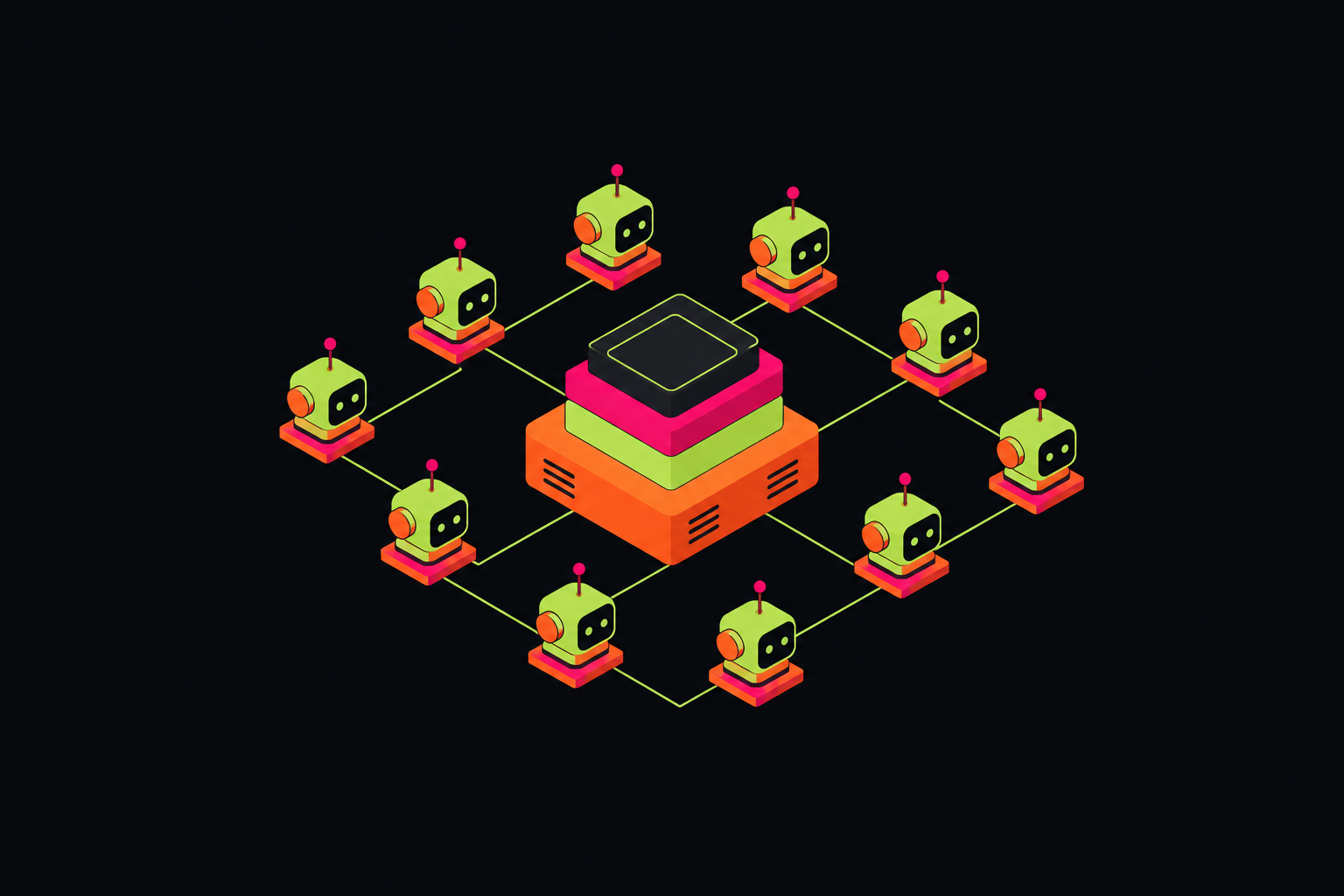
Running hundreds of persistent and scheduled autonomous agents reliably requires a runtime built around durable checkpoints, transactional shared state, per-agent isolation, and recoverable execution. Scheduling starts the work, but persistence lets it survive between steps, pauses, and crashes.
Why stateless infrastructure fails when agents run as persistent, goal-directed processes
The engineering distinction between a chatbot and an agent is an execution model. A stateless call takes an input, returns an output, and forgets. An agent may construct a plan, invoke a tool, delegate a subtask, revise its assumptions, and then take an external action. Its path emerges while it runs. The tenth step may depend on something learned during the third, so treating each call as an independent request breaks the workflow’s continuity.
What must survive between those calls? Session state holds short-term data for one interaction loop, often in RAM, while workflow state records the lifecycle of a task through reboots, crashes, and days-long pauses. A context window cannot substitute for that record because it is temporary and bounded by the session or token budget. Durable state preserves the facts, decisions, and progress needed after that boundary. Without it, an agent cannot reliably finish multi-step work, recover from an interruption, or demonstrate what it actually did.
What complete agent state actually contains and why each layer breaks differently under concurrent load
TiDB’s agent state breakdown separates conversation memory, task checkpoints, tool outputs, and files and artifacts. Conversation memory holds message history, preferences, and prior decisions, so losing it causes repeated questions and lost personalization. Task checkpoints save the current step, the work still to do, and branch decisions. Without them, a crash can force a full restart. These layers support different kinds of continuity, and saving one does not protect the other.
Tool state records what the agent did. It includes API pages already fetched, files written, and transformations applied. Losing those results forces the agent to make the same calls again, costs more, and can cause rate-limit collisions. Artifacts are what the work produces, including generated documents, intermediate outputs, and large payloads. Without durable artifact storage, even a computation that has finished can leave another agent with nothing it can use at the hand-off.
An agent that loses its checkpoint may repeat tool calls that already changed shared records, creating duplicate or conflicting work. Conversation history alone cannot show which actions finished. Metadata is also needed to record which model version ran a step and what permissions were in place. Without that context, anyone debugging or reconstructing an audit lacks the evidence needed to explain a decision.
How checkpointing works and what determines whether it holds under failure
Checkpointing writes an agent’s state transitions to durable storage so execution can resume from a saved point. A useful checkpoint includes message history, the current execution node, branch decisions, tool outputs, and environment metadata. The checkpointer interface links execution to the persistence backend, and a thread_id names the workflow thread whose state is being saved and restored. Recovery depends on the completeness of that snapshot. Saving messages but omitting tool results can force the agent to repeat rate-limited or side-effecting calls.
The ADEMA architecture study, identified as arXiv 2604.25849 in 2026, provides a concrete test of this dependency. In a fixed 60-run matrix, removing checkpoint/resume produced the only invalid run, giving checkpointing a clear empirical role in the tested architecture. Its scope is still that experimental matrix. More generally, resuming completed work rather than repeating it reduces both recovery time and redundant token spend.
Whether those saved transitions can be trusted under load depends on the backend. SQLite offers low operational overhead for single-process agents, but is not the concurrent-write foundation described for a fleet. PostgreSQL provides strong consistency, transactional integrity, and queryable records, making it the appropriate default for high-concurrency shared state. Redis offers fast reads and writes with time-based expiration, but documents and structured artifacts still need a separate storage layer. Speed alone does not define recovery fidelity.
Checkpoint formats also change as agent behavior evolves. Old checkpoints must remain readable through schema migration, or a saved workflow becomes unresumable. A write that succeeds today is therefore only part of the contract. The runtime must later interpret the execution node, stored results, and metadata well enough to continue the task.
Why concurrent agents create state conflicts that checkpointing alone cannot prevent
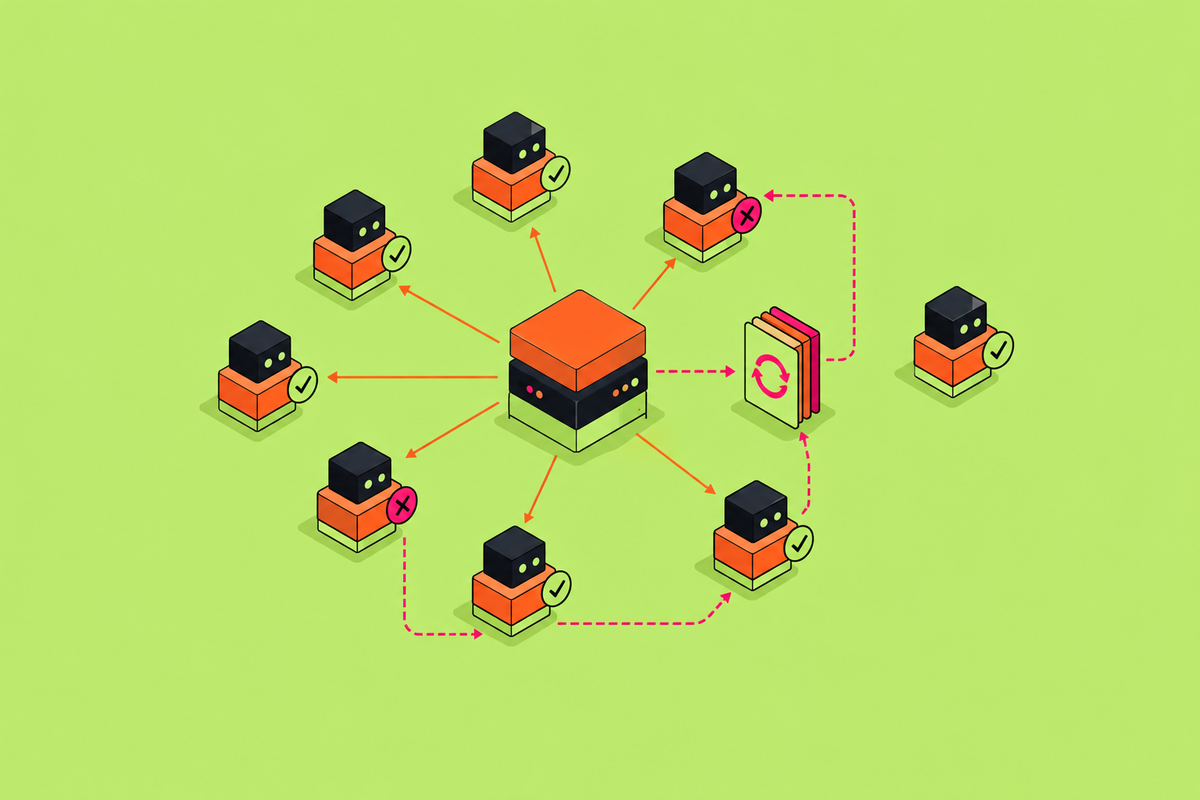
When two agents touch the same record, the question shifts from whether each can resume to whether both can act on a consistent view without overwriting each other’s progress. Agents in separate processes cannot share in-memory state as a durable source of truth. Without shared coordination over state, they may process the same input twice. Checkpointing preserves each agent’s progress, but does not by itself resolve that conflict.
Can shared files and locks solve the problem? File locks can mitigate simultaneous writes to one checkpoint file, but they do not provide a distributed isolation mechanism across nodes. A fleet instead needs database-level guarantees, including atomic writes, isolation between concurrent processes, and an auditable record. Atomicity means a transition fully commits or does not. Isolation addresses the separate question of how overlapping work interacts with shared state.
CoAgent, identified as arXiv 2606.15376 in 2026, examines concurrency control for multi-agent systems at the coordination layer. Its focus shows that researchers are still studying a problem that adding persistence alone does not solve. The cost is both logical and operational. Processing the same input or doing the same work twice wastes tokens even when the conflict does not immediately corrupt the output.
The fragmented state stack most teams actually build and where it breaks down
TiDB describes a common production arrangement consisting of a relational database for operational data, a vector store for retrieval, a Redis cache for session state, and a warehouse for analytics. Glue code connects their partial views of the workflow. Each extra system adds a place where state can drift and a boundary where failures must be managed. This is more than a maintenance burden. Apparent model unreliability can originate in infrastructure that supplies inconsistent or incomplete context.
Vector databases support semantic recall for knowledge-intensive agents, while high-speed in-memory stores support short-term working memory. A vector database still has limits for state problems such as tracking loop iterations. File checkpoints are portable, human-readable, and easy to set up, but encounter races and distribution limits. Key-value stores offer fast access and expiration, but need another layer for files and artifacts.
Human review exposes the seams particularly clearly. Without persistence, an agent waiting for approval must keep its process running and risk a timeout. With persistence, it can save state, shut down, and resume when a webhook arrives. The transition between saved progress, approval, and resumed execution is where fragmented systems must agree. Auditability suffers from the same fragmentation because reconstructing what an agent knew at one step requires joining evidence across the stores.
How should a team choose persistence for hundreds of long-running AI agents?
The decision begins with acceptable loss. For a short task handled by one agent in one process, in-memory state is acceptable if losing everything after a crash is an acceptable outcome. An hours-long, multi-step workflow needs file-based or database-backed checkpointing. Files offer easier inspection but do not distribute. When many agents touch shared records, a relational database with transactional integrity gives them the atomic writes, isolation, and queryable audit trail they need.
Memory and artifacts add needs of their own on top of that operational foundation. Knowledge-intensive agents can add a vector store for semantic recall across a long history. Embedding-backed memory extraction should run asynchronously after each conversation turn so extraction latency does not delay the user-facing response. Large binary outputs, such as images and PDFs, belong in a dedicated artifact store. The checkpoint should record a pointer to the payload.
An agent waiting for human review must serialize its state to durable storage and wake on an approval signal or webhook. Keeping a process alive is not a durability strategy. The WEB OF AGENTS position paper identifies state management as one of four foundational building blocks for collaborative agentic AI, requiring state that agents can address and transfer across instances. MCP and A2A handle tool access and coordination, but do not supply durable context, permissions, or rollback, so protocol support cannot substitute for a recovery design.
What crashes and runaway agents in production reveal about state durability gaps
Production incidents show why recovery must encompass saved conversations, permissions, information freshness, and rollback. PocketOS’s founder described the April 2026 database deletion as a systemic failure. A Cursor coding agent powered by Claude Opus 4.6 used an over-permissioned, unrelated API token found in the codebase to delete a Railway volume. The deletion removed the production database and all volume-level backups in nine seconds.
Amazon’s internal escalation from Q3 2025–March 2026 illustrates a different layer. Its internal memo grouped incidents under “Gen-AI assisted changes” and “high blast radius,” prompting extra senior review for AI-assisted production changes. In the incident described in the notes, an engineer acted on inaccurate advice that an agent inferred from an outdated internal wiki. The failure began with stale context. Preserving that context would not make it current, so durability alone cannot establish that the information guiding an action is trustworthy.
Neither establishes that every agent incident is a checkpoint failure. For concurrent fleets, however, shared state access expands the scope of damage when isolation or rollback is absent. An agent’s statement that recovery is impossible is also no substitute for an independently available recovery mechanism.
The architectural requirements a purpose-built agent runtime must satisfy to make fleet-scale durability tractable
A purpose-built runtime makes durability part of execution rather than a collection of connectors assembled around it. The distinction between an agent runtime and an agentic operating system concerns the breadth of control. The latter is a policy-controlled execution environment in which agents inspect context, call tools, and perform bounded actions while operators retain identity, isolation, audit, and rollback controls. Traditional systems manage processes, memory, and CPU time, while an agent OS manages concurrent agents, memory, context windows, and external API rate limits.
Checkpoint/resume must therefore be a first-class primitive, with per-agent state isolation enforced by the runtime. Concurrent agents must not accidentally share mutable state simply because their execution overlaps. Rollback must provide access to a prior checkpoint independently of an agent’s account of what can be recovered. An audit trail must make what the agent knew and did queryable at each step.
Permissioning and interoperability complete that execution boundary. Least-privilege access limits each agent to the tools and data its role requires, while transferable, addressable state supports collaboration without trapping progress inside one instance. A developer-first runtime can expose checkpointing, isolation, and rollback through clean primitives and a single-command installation. Ease of installation is not the durability guarantee. For persistent and scheduled agents at fleet scale, the decisive capability is preserving controlled, recoverable progress after the process that started the work is gone.