Agent Memory Interface Design Patterns
Choosing agent memory means trading accuracy against latency.

Memory decides whether an agent survives contact with production. Large language models retain nothing between API calls. Every form of persistence an agent displays, remembering a user's name, picking up a task from yesterday, avoiding a mistake it made last week, has to be built by hand.
Nothing about a model's weights changes this. A more capable model answers better within a single call, but the call still ends in a clean, total forgetting. The system prompt, the conversation so far, any tool output pulled in along the way: all of it vanishes the moment the response finishes generating, unless something outside the model catches it first. That catching, storing, and re-presenting of information is what people mean when they talk about agent memory, and it is an engineering layer, not a model feature.
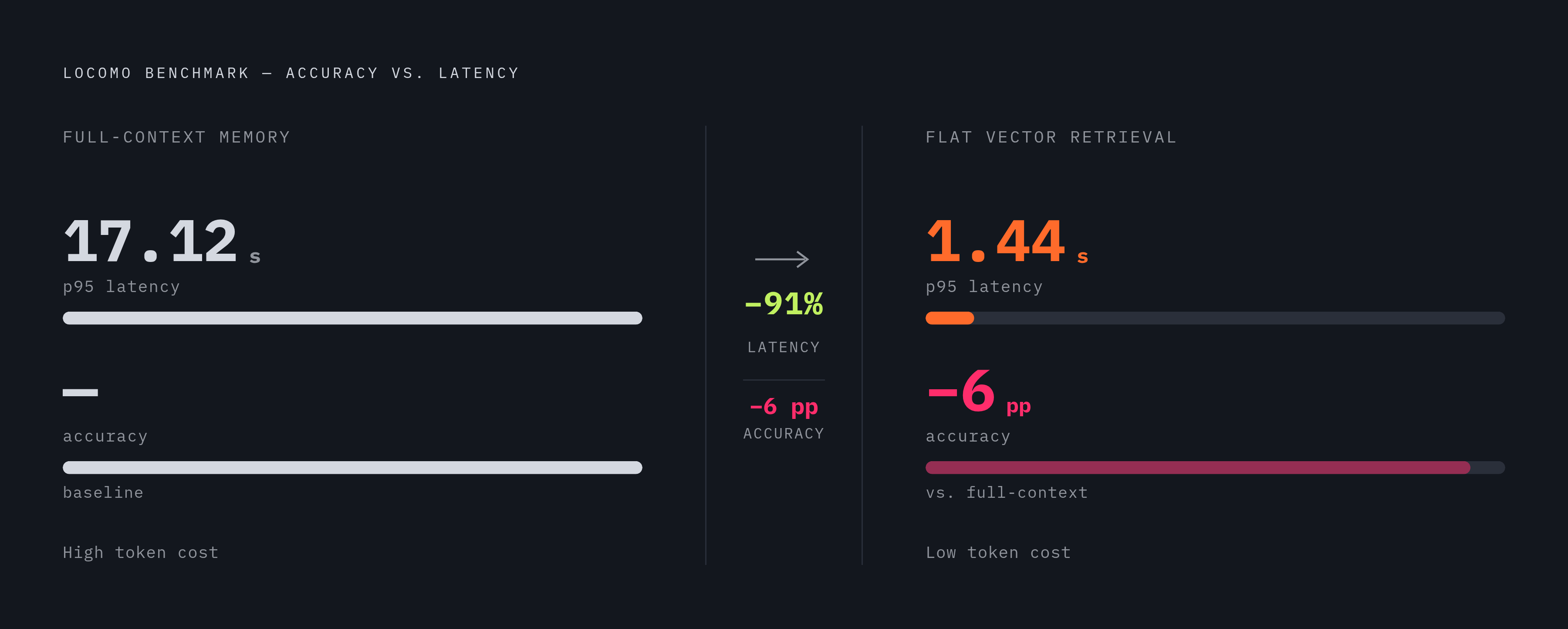
Getting this layer right carries real pressure, and that pressure appears as a cost problem before it appears as a quality problem. Large system prompts already take up a lot of the token budget before a single turn of conversation happens, and stacking raw conversation history on top of that burns through tokens at a rate that does not hold up at any real scale. The accuracy consequence is worse than the cost consequence. As context grows, the model's ability to use what's in it falls, not just the dollar cost of asking it. The "lost in the middle" effect (Liu et al., 2023, cited in Atlan) pins down why: relevant information placed in the middle of a long context gets used worse than information at the start or end, a problem that token budget alone does not solve. A bigger window does not fix this. Frontier models now ship with very large context windows, and that shift moves the accuracy and latency trade-off around, but it does nothing for the separate question of whether anyone can govern what's sitting in that context, who put it there, or whether it should still be trusted. On the LOCOMO benchmark, full-context in-process memory delivers the highest accuracy but burns tokens unsustainably and ends when the session does, while flat vector retrieval cuts latency by roughly 91% at the cost of about six accuracy percentage points, a trade-off that must be accepted deliberately.
The two axes that determine which memory architecture fits a given agent
Every memory architecture choice reduces to two independent questions, and neither one has a universally right answer.
The first axis is accuracy versus latency. A customer-service bot answering from a known product catalog can tolerate some imprecision if it means an instant response. A compliance agent reviewing a contract clause cannot trade accuracy away at any price, even if that means the user waits several seconds longer. Atlan's 2026 review puts numbers on this trade-off: full-context, in-process memory gets the highest accuracy available but at much higher latency and token cost, while flat vector retrieval cuts that latency drastically, on the order of a 91% reduction, at a real and measurable accuracy cost. Neither option is correct in the abstract. The agent can only afford certain failure modes.
The second axis is governance versus freshness. Unstructured memory, a pile of vectors or raw text chunks, is trivial to populate and nearly impossible to audit. Nobody can say with confidence which fact came from where, when it was true, or whether it's been superseded. A governed memory store, built on something like a metadata catalog or a knowledge graph with temporal edges, solves that problem but demands real upfront investment to build and maintain. The compliance agent cannot operate on a memory store where nobody can answer "where did this fact come from, and is it still true?" A larger context window does not touch this problem. Even a model that can hold enormous amounts of text in context still cannot tell you which part of that text has been revoked, approved, or flagged as policy-violating.
These two axes move independently of each other. A system can sit high on accuracy and low on governance, full context with no audit trail at all, or low on accuracy and high on governance, a tightly controlled metadata graph with strict provenance but limited reach. The patterns that follow each occupy a different point on this map, and picking one is really picking a position on both axes at once.
Pattern 1: in-process working memory
The simplest architecture available is also, for a real class of agents, the correct one: everything lives in the context window, and nothing persists outside it. The storage substrate is the context window itself. There's no retrieval mechanism to build because there's nothing external to retrieve from, and the agent sits as a passive recipient of whatever gets placed in front of it at inference time.
This pattern earns its keep through simplicity. There's no database to provision, no retrieval pipeline to tune, and no external store to secure. Every input the model sees is visible right there in the prompt, which makes debugging about as straightforward as it gets in this field. For a short-lived task agent, a single-turn tool, or a prototype built to test whether an idea works before investing in infrastructure, this is the right starting point, not a placeholder for something more sophisticated.
The ceiling is hard and unforgiving. When the session ends, the memory ends with it, and there's no fallback if the context window fills up mid-task. Worse, the lost-in-the-middle effect means that stuffing more into that window doesn't reliably buy more reliable recall. A longer context is not automatically a better one, even on models built to support very large windows.
The signal to move past this pattern is practical: token cost climbing past what the business can sustain at volume, a need to recall something from a session that already ended, or a task that simply runs longer than one context window can reliably hold mean it's time to add an external store.
Pattern 2: context plus retrieval store
This pattern runs underneath most production agents today, the coding assistants, the customer-service bots, the enterprise copilots that actually ship. Working memory still lives in the context window for the active turn, but long-term records move into an external vector store or structured database, with a retrieval pipeline pulling relevant pieces back in at each step. Retrieval generally runs as top-k semantic search, and control shifts from the passive model of Pattern 1 to something more active: the agent, or a retrieval controller sitting beside it, decides what to pull in.
The speed gain over full-context is not a marginal improvement. Mem0's LOCOMO benchmark data, cited by Atlan, puts flat vector retrieval at roughly 1.44 seconds p95 latency against 17.12 seconds for full-context, a 91% reduction, alongside a substantial cut in token cost. At scale, that latency reduction and token savings produce a genuinely different cost profile.
It comes with a price that has to be named, not glossed over. The same benchmark shows roughly a 6-percentage-point drop in accuracy against full-context. Teams that treat the latency win as free speed are, in practice, shipping an agent that gets fewer answers right, and that trade needs to be a deliberate choice rather than an accident of architecture.
Retrieval quality degrades without throwing an error: the agent confidently answers from a chunk that's stale, mismatched to the question, or missing exactly the information needed to answer it correctly, and nothing in the output signals that anything went wrong. The user gets a wrong answer with no trace back to the cause. This is why retrieval needs its own evaluation, separate from evaluating the model's generation quality. The Taskade 2026 field guide treats retrieval-augmented generation as its own distinct readiness pattern for exactly this reason: retrieval and generation are different engineering problems and need different testing. Augment's 2026 pattern guide makes a related point about agent workflows generally: auditability moves from the code to the run itself, the trajectory the agent actually took, which is what forces logging, bounded execution limits, and human approval steps into the architecture alongside the retrieval layer.
Pattern 3: episodic memory
Transcripts don't scale. An agent handling a weeks-long procurement workflow or an ongoing customer relationship cannot reasonably re-inject the full history of every exchange at every turn, so the practical answer is to store what happened as compressed summaries instead of verbatim conversation logs. That compression is real and valuable: a summary lets an agent reference weeks of prior interaction without paying the token cost of the full transcript.
The problem occurs once those summaries start summarizing each other. A summary written at the time may leave out a detail nobody thought was important yet, and that detail can turn out to matter later, once circumstances change. The agent then acts on a record of events that's incomplete or subtly wrong, with no transcript left to check against. This drift compounds specifically through repeated cycles: each time a summary gets re-summarized, it moves further from what actually happened, and there's no natural point where that drift corrects itself.
The practical defense is to keep the raw record somewhere cold, alongside the summary, so retrieval can fall back to the source when precision actually matters, and to vary how granular the summarization is depending on the task rather than applying one compression ratio everywhere. Episodic memory earns its place in architectures built for long-running work, a compliance audit, a procurement process, a relationship that spans months, where what was decided and why matters more than the exact phrasing used to decide it.
Pattern 4: procedural memory
Episodic memory stores what happened; procedural memory updates the rules the agent follows on its next run. It operates on the agent's behavior itself rather than on its context.
The mechanism is direct. After completing a task, the agent, or a controller sitting outside it, identifies what worked, writes that insight down as an instruction, and feeds that instruction back into the system prompt governing future sessions. An incident-response agent built this way learns over time which runbook to reach for first, which alerts tend to be noise, and which escalation steps can be skipped without missing anything. That's compounding improvement, and it's genuinely valuable in agents that run the same category of task over and over.
It also carries the sharpest risk of any pattern covered here. If the rule written back is wrong, built on a biased sample, or drawn from a handful of atypical cases, the agent doesn't just make one bad call. It misbehaves systematically across every future session, in a way that's genuinely hard to trace back to the one rule change that caused it. A rule written into a system prompt functions as a code change to the agent's behavior, and it deserves the same audit trail and rollback path that a code deployment gets, not a lighter one. The Agent Operating System reference architecture, described in arXiv:2608.03214 from August 2026, assigns exactly this kind of auditability and human oversight to what it calls its Control and Governance Plane. Procedural memory is the case that plane exists to govern, and it's the clearest argument in this entire taxonomy for why interface design and human oversight can't be an afterthought bolted on once the memory layer is working. Cursor's production approach offers a useful comparison at a different level: its Tab completion model gets retrained roughly every 90 minutes based on real user accept and reject signals. That's compounding feedback operating on the model itself; procedural memory applies the same principle one level up, at the level of agent behavior rather than model weights.
Tiered memory with a controller
Long-horizon agents eventually outgrow every pattern above, and the architecture they graduate into layers several storage types under a single controller that actively decides what to keep, compress, retrieve, and throw away. The stack typically looks like a context window for working memory, paired with a structured database, a vector store, and a cold archive, with the controller making an active decision about memory state at every step rather than passively serving whatever's closest at hand.
What changes here is the agent's relationship to its own memory. Instead of just retrieving from a fixed store, the controller decides what gets remembered in the first place, which moves the agent from a passive recipient of context to an active manager of its own memory state. The arXiv survey on memory for autonomous LLM agents points to MemGPT and to AgeMem, from Yu et al., 2026, as working examples of this pattern already running in production.
Tiered memory relocates the drift problem instead of removing it. A controller that evicts or compresses information it judged unimportant at the time can lose exactly the detail that turns out to matter later, which is the same failure episodic memory runs into, just moved inside an automated component instead of a single summarization step. Adding more layers and more automation doesn't remove the underlying risk; it just changes where in the system that risk lives.
One variant of this pattern sidesteps part of the problem rather than solving it. Atlan's 2026 taxonomy describes this as a fifth pattern: instead of building a free-form vector store, the agent draws on an organization's existing governed metadata graph as its memory substrate, pulling certified definitions, data lineage, and access policies directly from a system that was already built to be audited. That buys real governance, but it comes at the cost of freshness. Memory in this variant is only as current as the metadata catalog behind it, even though every fact it does return carries a clear, traceable origin. Tiered memory and governed-substrate memory both represent the same basic bet: that for a long enough task, the complexity of managing memory deliberately is cheaper than the cost of getting it wrong silently. Which of the two makes sense for a given agent comes back, again, to where that agent sits on the two axes laid out at the start: how much latency and governance it can actually afford to spend.
Sources
- Memory for Autonomous LLM Agents:Mechanisms, Evaluation, and Emerging Frontiers
- Memory in the Loop: In-Process Retrieval as Extended Working Memory for Language Agents
- Always-OnAgents:A Survey of Persistent Memory, State, and Governance in LLMAgents
- AI Agent Memory Design Guide - Working, Long-Term, and Procedural Memory with Forgetting and Staleness Management | hidekazu-konishi.com
- Agentic Context Management: Solving Agent Memory and Cost by Treating Them as Lifecycle and Architecture Problems
- aaif.io
- Managing Procedural Memory in LLM Agents: Control, Adaptation, and Evaluation