Episodic Memory Retrieval in Production Agent Systems
Episodic memory lets agents learn from past sessions, unlike RAG or context windows.

LLM agents start every session blank. Episodic memory fixes this by storing what happened in past sessions, and it works on different principles than retrieval-augmented generation or the context window, even though all three get lumped under "memory" in casual conversation.
Why episodic memory differs from RAG and working memory
The context window is working memory. It's fast and precise while the session runs, but it clears the moment the session ends, and the next session starts over from nothing. That reset is fine for a single task done once. It becomes a real cost once an agent is expected to run the same kind of job, for the same user, over weeks or months.
RAG and episodic memory share the same retrieval machinery, embeddings, similarity search, nearest-neighbor lookups, which is probably why people mix them up. But they answer different questions. RAG answers "what does the documentation say." Episodic memory answers "what happened the last time I did this." There's a clean test for telling them apart: wipe the store and see what's lost. If the wipe destroys knowledge some person wrote and uploaded, that was RAG. If the wipe destroys what the agent itself learned from doing the work, that was memory.
Production agents need both, and treating them as the same system is a design mistake, not a style choice. A support agent might pull a refund policy from a RAG store and, separately, recall that this particular customer's last three tickets were all shipping delays. Episodic memory survives from one session to the next: it holds the action the agent took, the context it took that action in, and what came of it. A database engineer's agent that says "the last time a query plan regression looked like this, the cause was a missing index on the foreign key" is drawing on exactly that kind of record. That judgment came from a specific past case, not a fact pulled from a manual.
An agent that skips episodic memory doesn't just lose a nice-to-have feature. It turns into an expensive chatbot that treats every repeat incident, every returning user, every routine task as something it's never seen before, no matter how many times it's actually run through it.
What the memory layer has to do
A memory layer built for agents has to serve query patterns that ordinary databases, and even the vector stores teams already use for RAG, were never built to handle. Four separate requirements appear once an agent starts running continuously, and each one rules out treating memory as an afterthought bolted onto existing storage.
The first is semantic retrieval: an agent doesn't query with a key, it queries with a chunk of natural-language context, so the store has to be built around similarity search rather than exact match. The second is temporal organization: recency has to work as something the system can query against directly, because a timestamp sitting quietly in a log isn't enough. An agent needs to be able to ask for what changed recently versus what was true before, and get that distinction back as part of the answer. The storage layer underneath has to absorb that constant flow of agent-produced experience, every action and every outcome, without turning into a bottleneck sitting in the middle of the agent's main loop.
The field moved in 2026 from worrying mainly about retrieval to worrying about formation, consolidation, and personalization. Fast lookup over stored memories still requires something upstream deciding what gets written into the store. Something has to decide which experiences are worth keeping, merge memories that describe the same underlying event, update facts that have gone stale, and prune low-value records before they crowd out the memories that matter. Proposals such as Governed Evolving Memory treat this as a data-management problem in its own right, one where correctness is judged across the whole trajectory of the agent's state rather than record by record. A single memory can look perfectly fine in isolation and still be wrong in context, if it contradicts something learned later or no longer applies to how the system behaves now.
Simply appending every memory without ever updating or deleting creates its own failure mode. Over time the agent can end up holding beliefs that no longer match what actually happened, a kind of drift between what's recorded and what's true. The memory layer sits between the context window and whatever persists long-term, and its job really comes down to three things: deciding what gets written down, pulling out what's relevant to the current task, and managing how long any given memory stays useful before it should be retired. A vector store by itself does none of that work; it only stores and searches what it's given.
None of this is solved reliably yet. Teams routinely underestimate what it takes to handle memories that contradict each other, to resolve a single identity across different sessions and different devices, and to keep retrieval accurate once the store has grown past a few million interactions.
The three retrieval patterns production teams choose between
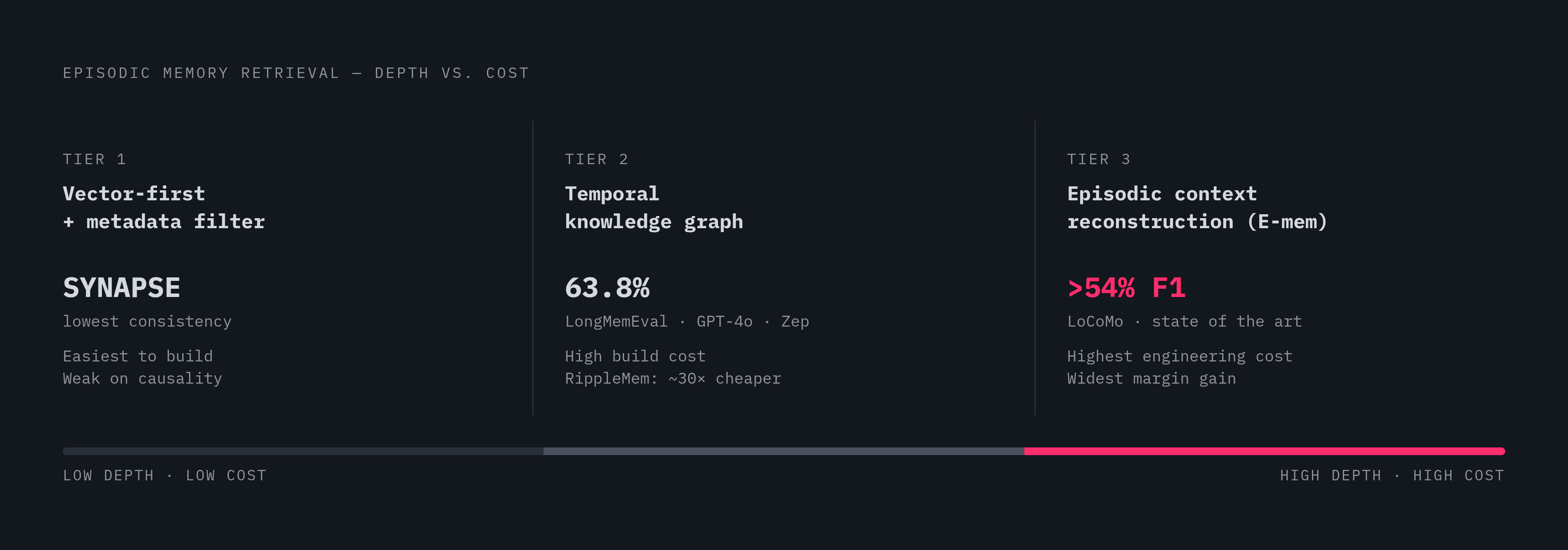
Three distinct retrieval architectures are visible across production systems today, and each one trades off cost, accuracy, and reasoning depth differently. Picking one isn't a neutral infrastructure decision: it quietly sets limits on what kinds of questions the agent can answer with any reliability later on.
The first pattern is vector-first retrieval with metadata filtering. Memory gets encoded as embeddings in a vector database, and retrieval runs on semantic similarity, narrowed down by metadata filters for which user or agent the memory belongs to and how recent it is. This is the pattern most teams reach for first, since it's simple to build and the tooling around it is mature. It works reasonably well for episodic memory in general. Its weak point occurs when a complex chain of cause and effect gets compressed into a flat embedding: the sequence that mattered gets flattened into a single static vector, and the links between steps become very hard to recover at query time. Benchmark results from SYNAPSE back this up directly: a "vectors only" setup, relying purely on geometric similarity in embedding space, comes in lowest on tests of consistency over long stretches of interaction.
The second pattern is the temporally aware knowledge graph. Facts change over time, and a graph that keeps historical relationships intact can answer "what was true back then" right alongside "what's true now," instead of only ever returning the current state. Zep's Graphiti architecture is built around exactly this idea, combining conversational history with structured business data while keeping the time dimension of each relationship intact, and it scores meaningfully higher on LongMemEval than flat vector approaches do. SYNAPSE takes a related but different route here, using lateral inhibition and temporal decay to light up the relevant sub-graph for a given query while damping down noise from unrelated parts of the graph, an approach closer to spreading activation than to plain similarity search. The catch with graphs is construction cost. Building and maintaining them is expensive, which is part of why RippleMem's event-centric graph design matters: it cuts construction cost by roughly 30 times compared to other graph-based memory approaches while still supporting associative recall.
The third pattern is episodic context reconstruction, built around multiple cooperating agents rather than a single store. E-mem takes this approach: instead of compressing memory down into embeddings or a graph ahead of time, separate assistant agents each hold onto uncompressed memory for their own segment of the conversation or task, and a master agent routes queries and pulls their answers together. The assistants aren't just handing back raw text, either. They reason locally inside their own segment first and extract evidence that's actually relevant to the query before the master agent ever sees it. This setup keeps causal chains and sequencing intact in a way that compression simply can't, at the cost of a more complicated architecture and the overhead of running several small language models as dedicated memory units. The results back up the tradeoff: E-mem posts state-of-the-art numbers on the LoCoMo benchmark, over 54% F1, beating prior approaches by a wide margin, while using substantially fewer tokens than approaches that just feed the full context back in.
RippleMem's adaptive associative recollection sits in between the graph pattern and the reconstruction pattern. It starts from a small set of recalled anchor memories and expands outward through linked episodic memories to fill in missing evidence, treating what it first retrieves as a lead to follow rather than a final answer. That design cuts graph construction cost substantially while still beating both flat retrieval and undirected graph expansion on LoCoMo and LongMemEval-S.
Vector-first retrieval is a sound place for most teams to start. Graph-based retrieval earns its added cost once temporal accuracy and multi-hop reasoning actually matter to the task. Episodic context reconstruction is the frontier choice for agents that need to preserve causal integrity over very long stretches of interaction, and it asks for more engineering effort in return.
How the leading 2026 memory frameworks implement these patterns
The frameworks built around these patterns aren't just different skins on the same idea. Each one embeds a different answer to who actually controls memory formation, and that choice is where each system tends to strain once it's under real production load.
Letta, formerly known as MemGPT, uses a three-tier model: core, archival, and recall, which maps onto the episodic, semantic, and procedural split described earlier. Moving memories between those tiers happens entirely through function calls the LLM itself makes, so the agent has full say over what it keeps and what it lets go. Letta rebuilt its core agent loop in October 2025, and in February 2026 added Context Repositories, git-backed memory, as part of Letta Code. It suits teams that want explicit, OS-style control over memory and are comfortable handing the agent real authority over its own memory lifecycle.
Zep is built around Graphiti, its temporally aware knowledge graph that combines conversational and structured business data while keeping the history of each relationship intact. On LongMemEval with GPT-4o, Zep reaches 63.8% accuracy, well ahead of flat vector-store approaches. It's a strong fit wherever facts genuinely change over time and the agent needs to tell "what was true then" apart from "what's true now." The tradeoff is the same one graphs carry generally: building and maintaining the graph gets more expensive as the web of relationships it tracks gets richer.
Mem0 positions itself as a persistent-memory layer that works across vendors rather than locking into one. As of May 2026 it integrates with all three major agent runtimes, Anthropic, OpenAI, and Google ADK, and it has a large open-source community that's still growing quickly. Its 2026 ecosystem report covers a wide range of frameworks and vector stores across three different hosting setups: managed cloud, self-hosted open-source, and local MCP. Mem0 fits teams that want to move fast across multiple vendors and would rather run a managed service than stand up their own infrastructure. The tradeoff is direct: going with a managed service means giving up some control over the exact logic of how memories get formed, in exchange for shipping faster.
Then there's model-native memory, built directly into the major model platforms themselves. Google launched Memory Bank at Google Cloud Next 2026, an identity-scoped database primitive built into the Gemini Enterprise Agent Platform. OpenAI's file_search tool, part of the Responses API, works as a vector-store-backed retrieval mechanism. Both are convenient if a team is already committed to that vendor's stack. But the API a team builds on now quietly sets the default memory model it's working with going forward, and these aren't interchangeable choices: moving between them later is a real migration, not a config change.
A question that doesn't belong to any single framework sits behind all of these: who manages the runtime that memory lives inside. An agent operating system gives agent state its own identity, isolation from other agents, durability across restarts, and a way to recover cleanly after a crash, instead of leaving a team to stitch those properties together by hand out of separate cloud services. The AIOS framing describes this as a kernel that isolates memory, storage, context, scheduling, and access control for every agent running concurrently, and security research from Microsoft makes the case that clear trust boundaries between different types and scopes of memory, along with real controls over who can read and write to each, are necessary rather than optional. For teams building agentic software meant to hold up under real production load, a purpose-built agent OS is the substrate that makes formation, retrieval, and staleness handling tractable at scale, rather than something assembled after the fact from general-purpose cloud tools. Read against everything above, that's less a product pitch than the logical place all of this infrastructure ends up living.
Memory formation: why what gets written is as important as what gets retrieved
Retrieval gets most of the attention because people can see it happen: a query goes in, a memory comes back, and the system either looks smart or doesn't. Retrieval can only surface what formation decided to keep. A system with excellent retrieval and poor formation just retrieves bad memories faster.
Think about what formation actually has to decide, moment to moment. Is this experience worth storing at all, or is it noise that will just crowd out something more useful later? Does it match an existing memory closely enough that the two should merge into one, rather than sitting side by side as near-duplicates? Has something changed since a memory was written such that it no longer reflects reality, and does it need updating instead of just getting old quietly in the background? Should it eventually be let go, the way a person naturally stops recalling a minor detail that never came up again? Whether retrieval has good material to work with depends on the answers to these questions.
Contradiction and staleness appear here too as operational problems rather than theoretical ones. An agent that logged a database configuration detail has no built-in way of knowing that detail changed, unless something in the formation process is actively checking and updating records like that one. Multiplied across millions of stored interactions, the gap between what the agent believes and what's actually true becomes the main source of bad answers, outranking anything retrieval could fix on its own.
Teams that treat memory as a solved problem once they've picked a vector store or a graph framework have only solved the easy problem of storage. Deciding what deserves to be written down, kept, merged, updated, or forgotten is the real engineering work, and most roadmaps still leave it for later.
Sources
- Episodic Memory for AI Agents: How It Works
- State of AI Agent Memory 2026: Where AI Memory is Heading - DEV Community
- E-mem: Multi-agent based Episodic Context Reconstruction for LLM Agent Memory
- RippleMem: From Isolated Retrieval to Associative Recollection for Long-Term Agent Memory
- AI Agent Memory Layer: Episodic, Semantic, Relational (2026)