State Isolation Between Concurrent Agent Instances
Isolating agent state prevents silent failures in concurrent deployments.
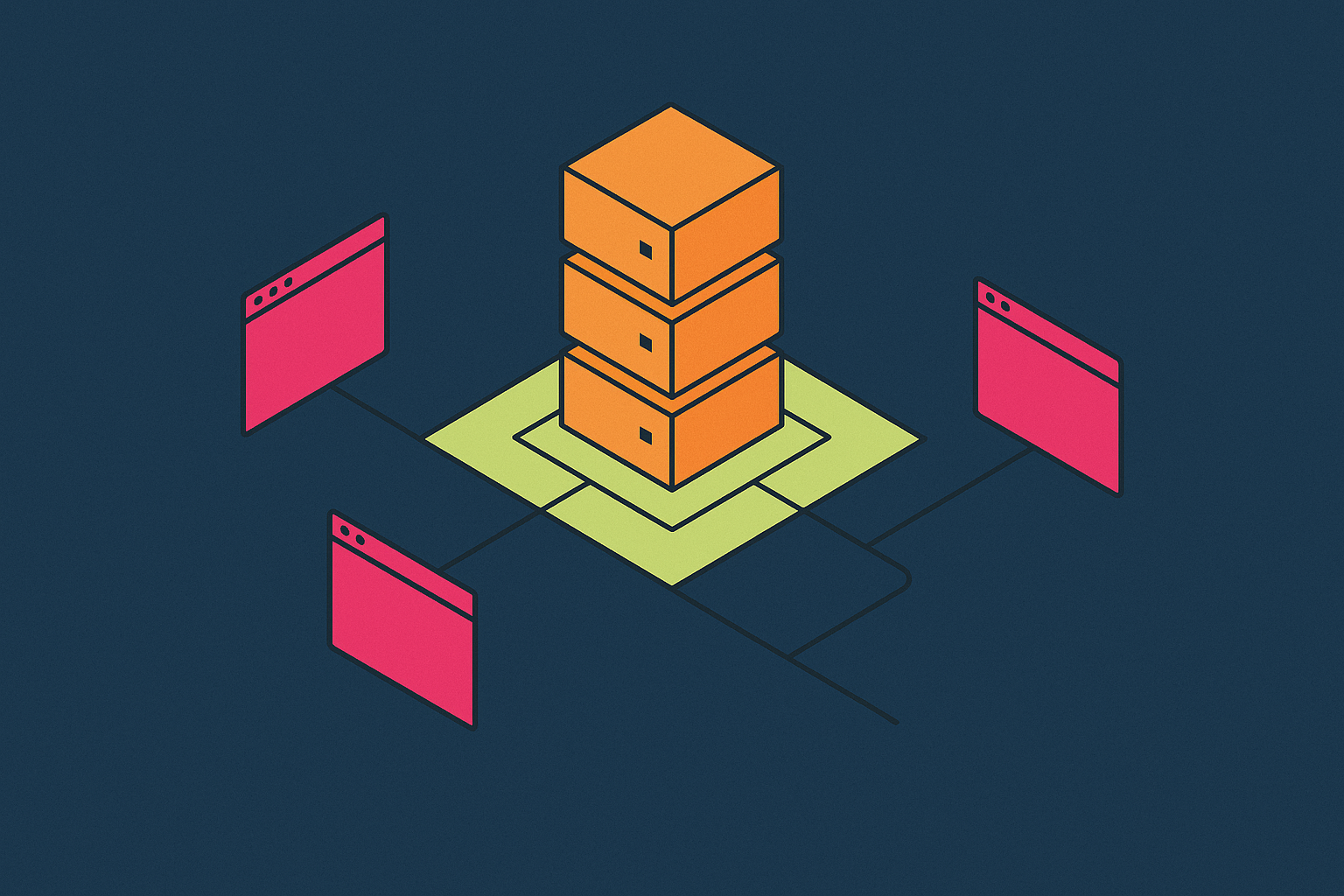
Most single-agent failures are visible: a bad tool call, a wrong answer, a loop. The failures that break concurrent agents are different. They are silent, they compound, and they appear the moment a second instance starts. State isolation is the fix, and it has to live in the runtime, not in the framework.
Why single-agent assumptions break the moment a second instance starts
Run one agent alone and state is just a file path. A context file, an auth token, an inbox, a working copy of the codebase. Nothing contends for any of it, so nothing needs to be designed for contention.
Start a second instance and that changes fast. You are running the hotfix agent and the feature-branch agent at the same time, and now the auth token is shared. The working copy is shared, so two agents produce conflicting diffs against the same file.
These are not edge cases that appear under stress. The agents report success while the state they produce is corrupt. That is the shape of the problem this article is about.
Why the framework layer does not solve this by itself
The natural objection is that the agent framework handles concurrency. It does not, not at the level that matters. Concurrency at the framework level does not equal isolation at the state level. If a single agent instance holds mutable state, a message list or an internal cache, concurrent calls interleave writes. One call's tool result corrupts another call's reasoning trace. Early frameworks treated each invocation as stateless and synchronous. That worked for demos. It collapsed in production when developers discovered that shared tool executors, global message histories, and thread-unsafe memory stores caused agents to hallucinate based on each other's actions.
The architectural conclusion that emerged is blunt: each agent instance must own its reasoning context entirely, with no shared mutable state in the hot path. It is a precondition for correctness. Isolated runtimes keep the main context small and return only a final summary.
The database-layer failure that framework isolation cannot prevent: write skew
Even when each agent instance owns its reasoning context cleanly, agents that share a backing data store run into a class of anomaly that database theory characterized decades ago. It becomes acute for agents specifically because of inference duration. Imagine two on-call agents, each asked to ensure someone is covering the queue. Each reads the schedule, sees the other is marked active, and decides it can safely go off duty. Each writes to a different row. No individual write is wrong, no row is overwritten. Yet together their writes leave the queue uncovered. That is write skew. What makes this structurally worse for agents than for ordinary services is time. Only read validation removes stale decisions, and the throughput column is its price.
Agents also produce a further layer of anomalies that have been named: semantic read skew, where one run reads the old index in step 1 and writes its answer against the rebuilt index in step 2. Merge skew. These arise from the multi-step, long-duration nature of agent work, not from classic transaction patterns.
How the blast radius of a shared runtime is determined by what the database role can reach, not by how well the model reasons
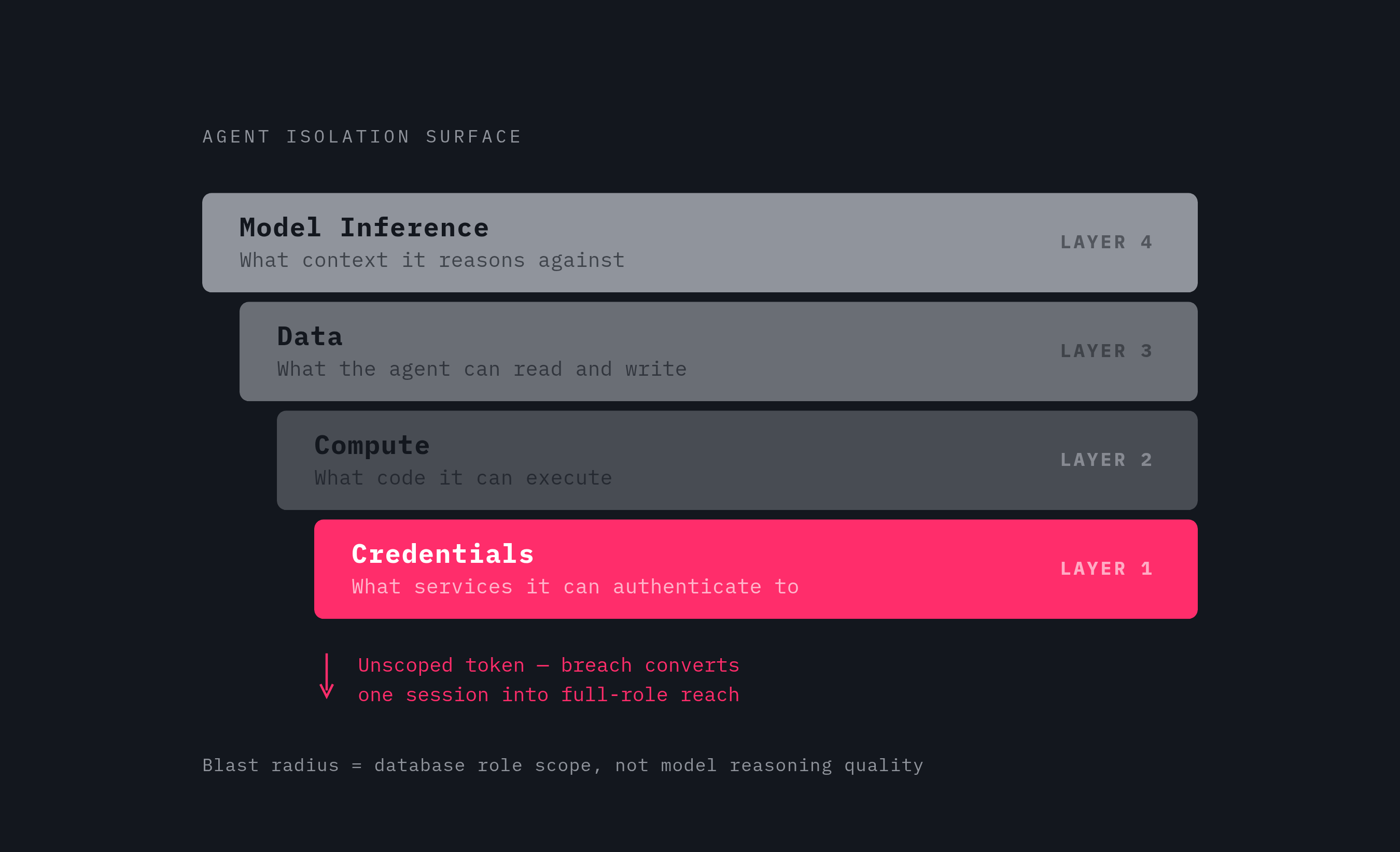
Concurrency failures are not bounded by reasoning quality. In one documented incident from April 2026, a single agent action deleted a production database and its co-located backups in seconds. The CockroachLabs post on agent loops and production database patterns frames this as a direct function of role permissions, not model behavior.
The isolation surface spans four distinct layers. Data is what the agent can read and write. Compute is what code it can execute. Credentials are what services it can authenticate to. The model inference layer is what context it reasons against. A session that breaks out of its sandbox can reach credentials it was never intended to hold, because the token was never scoped to a single session in the first place.
Security follows isolation. When each session holds its own credentials in its own worker, a compromised session can reach only what it was explicitly granted. The blast radius is bounded by design, not by hope. Conversation thread continuity that spans session boundaries enables cross-session instruction persistence, where a malicious payload injected in one session remains active in later sessions days or weeks afterward.
What agent state actually consists of and why statelessness is not a valid production posture
Agent state is not the same as a chat transcript or a context window. The context window is temporary. It disappears when the session ends or the token budget runs out. State is what survives past that boundary: the specific facts, decisions, and progress an agent needs to pick up exactly where it left off after a restart, a crash, or a gap between sessions.
The TiDB piece on stateful AI agents distinguishes state into layers that must each be handled explicitly. Tool outputs are results from API calls, searches, and computations, which avoids re-running expensive or rate-limited calls. Files and artifacts are generated documents, intermediate outputs, and large payloads.
A stateless agent that forgets everything between calls cannot finish a multi-step task, cannot recover from a mid-workflow crash, and cannot show what it actually did. The fragmented stack that most teams reach for, a database for operational data, a separate vector store for retrieval, a cache for session state, is usually where reliability breaks down. Each extra system is another place state can drift out of sync.
The four-scope memory model emerging in 2026 practice distinguishes run_id scope, which covers one execution only. Agent_id scope covers all users for one agent. User_id scope covers all sessions for one user. App_id scope covers all agents in an application or organization. Isolation strategy must be applied at each scope independently.
The per-session state directory pattern: making every shared path explicit and then eliminating it
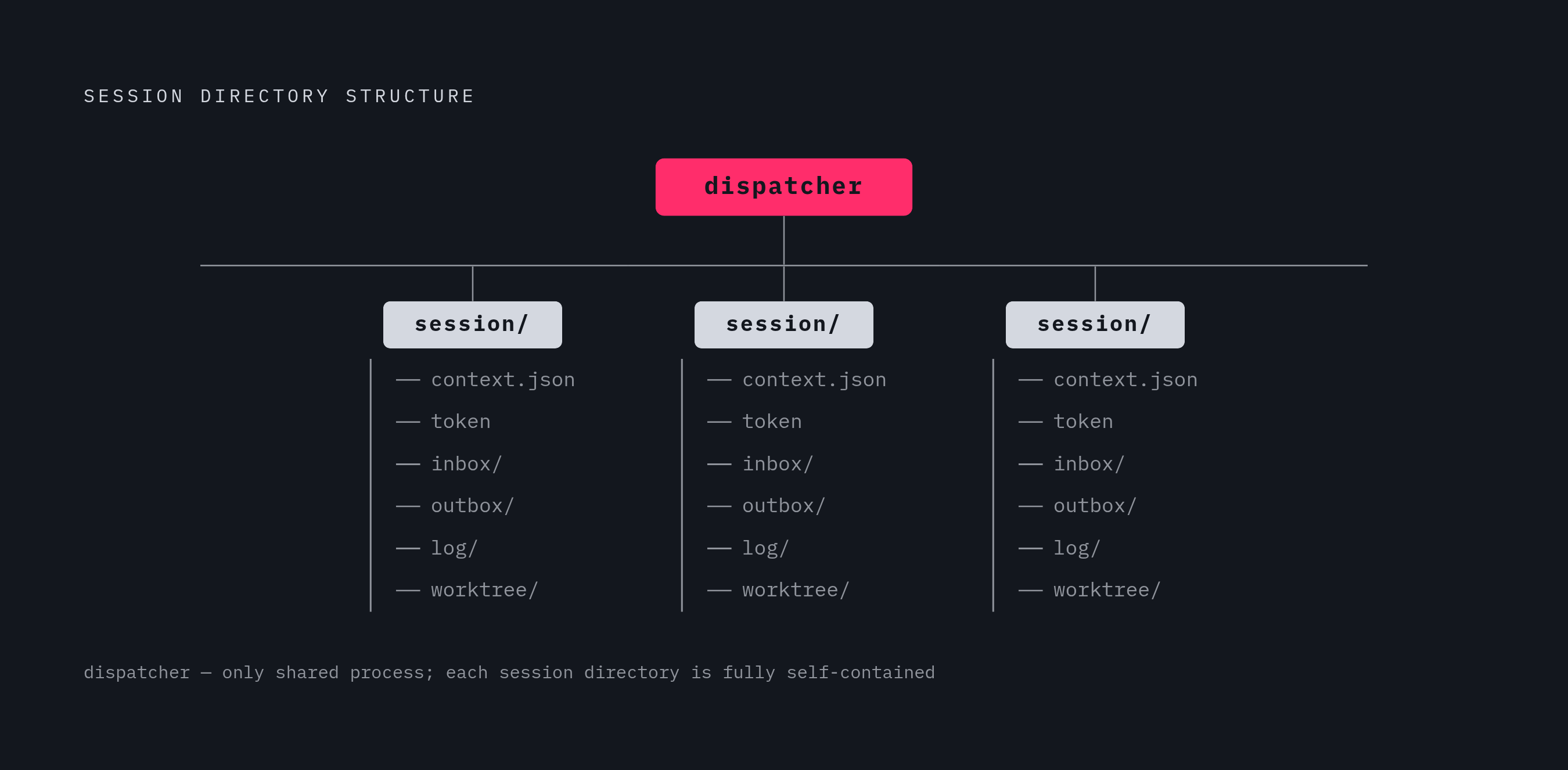
The practitioner solution that recurs across production teams is a per-session state directory paired with a thin dispatcher. Every shared path is a coupling point. One state directory per session makes the coupling explicit and pushes the only shared thing, the dispatcher, into a single, small, testable process. Each session directory holds its own set of files:
session/
context.json    # working memory, scoped to this session only
token           # auth credential issued for this session, revocable alone
inbox/          # incoming events, polled by exactly one process
outbox/         # outgoing events, written by exactly one process
log/            # per-session audit trail
worktree/       # optional, when the session owns a branch
The dispatcher is the only process that communicates with all sessions. One process per session means no two sessions share a poll consumer, an event loop, or a context file. Each session runs in its own process with its own current working directory and its own environment.
The dispatcher typically grows into five primitives: agent, a single subagent. Parallel, a fan-out with a barrier. Pipeline, a multi-stage without a barrier. Phase, progress grouping for observability. And log, status messages. Per-session isolation also enables safe provider mixing: cheap local models for some sessions, frontier models for others, with no risk of token cross-contamination between sessions.
Git worktrees as the filesystem isolation primitive for coding agents
When multiple AI coding agents operate concurrently in the same working tree, the failure modes are severe. Concurrent git add operations corrupt the staging area. The agent's mental model of the codebase diverges from what is actually on disk.
Git worktrees have emerged as the dominant isolation primitive for this problem. Each agent gets its own checked-out working directory while sharing a single git object store. This eliminates file-level conflicts without the overhead of full repository clones. The boundary the git documentation specifies precisely: each linked worktree maintains its own HEAD, index, and working files. The object database, remote configuration, and packed refs are shared.
But the critical boundary that worktrees do not enforce is external state. Worktrees handle the git layer. Containers handle everything external to git.
Durable checkpointing and serializable isolation: the two guarantees agents need from their data layer
The per-session directory and git worktree patterns handle the filesystem and process layers. The data layer requires two distinct guarantees that must be specified explicitly: durable checkpointing, so the agent can survive a restart and resume from an exact point, and serializable isolation, so concurrent agents cannot produce write-skew anomalies against shared state. Durable checkpointing means session state persists outside the model and is keyed to a thread or session identifier. A server restart does not require restarting the task. LangGraph 1.0, GA October 2025, stabilized this as a first-class primitive with checkpoints keyed by thread_id. The data layer needs explicit configuration rather than inherited defaults.
Side effects are a special case. Either both the data commit and the effect land, or neither does. The production agent stack therefore requires three things: atomic writes, so no partial task state. Isolation between concurrent processes, so no write skew. And a durable audit record. These are the same guarantees a database gives any application, applied consistently across every layer of agent state.
Why agent memory across sessions needs actor-tagged, scoped storage rather than a shared pool
Cross-session memory is what separates a useful agent from an expensive chatbot. An agent that forgets everything the moment the context window resets cannot build on prior work, cannot maintain user preferences, and cannot operate on a schedule. Persistence and proactivity require an intentional external memory layer, not a larger context window.
The four-scope memory model, run_id, agent_id, user_id, and app_id, is the design frame that makes isolation tractable. Each scope has a different lifetime, a different set of legitimate readers, and a different risk of contamination if boundaries are not enforced. In multi-agent systems, a shared memory pool without actor tagging creates a cross-agent contamination path. Agent A's conclusions about a user's preferences or a system's state can be read by Agent B without any indication that the source was a different agent with a different task, different permissions, and potentially different information quality.
Actor-aware memory stores tag each memory entry with its source agent, preventing cross-agent contamination. Temporal knowledge graphs extend this further with time-aware edges, enabling what-was-true-when queries that matter for long-running workflows where the world changes between agent runs. The security implication of unscoped persistent memory is concrete. Conversation thread continuity that spans session boundaries enables cross-session instruction persistence. A malicious payload injected in one session remains active in later sessions. In multi-agent pipelines, User to Agent A to Agent B to Agent C, each agent adds to a persistent thread, so a compromised memory entry propagates across all downstream agents.
What the emerging agent OS framing means for teams building concurrent agent infrastructure today
The patterns in the preceding sections are individually correct but collectively ad hoc. Per-session directories, git worktrees, serializable isolation, actor-tagged memory. Most agent stacks today resemble bare-metal systems that force bespoke solutions for state management, tool access, concurrency, and security. The effort is duplicated across teams, and the deployments are brittle.
Academic and industry framing is converging on an Agent Operating System as the missing substrate. It is the layer that isolates memory, storage, context, scheduling, and access control into a kernel managing concurrent agents, analogous to what the OS was for applications. Four behaviors force the issue and cannot be resolved at the framework layer. Agents run for minutes or hours, so a request-response server times out. Coding agents write and execute their own code, so shared compute is a liability. Multi-agent systems fan out and call each other, so queues and durable workflows are required. Agents carry memory across sessions, so state must survive a restart.
The three layers of the 2026 agent stack are now distinct enough to name. The framework is the code that defines agent logic. The runtime is the infrastructure that executes that logic with isolation, scaling, and state. The platform sits above. Mixing these layers up is the most common reason an architecture conversation stalls, because solutions appropriate at one layer are not transferable to another.
Microsoft's April 2026 open-source Agent Governance Toolkit operationalized a piece of this at the policy layer. It is an Agent OS component that you can think of as the kernel for AI agents: a stateless policy engine that intercepts every agent action before execution at sub-millisecond latency, covering all 10 OWASP Agentic Top 10 risks, 7 fully and 3 partially per the toolkit's own self-assessment. That is a signal. The industry is codifying the runtime layer as a distinct engineering concern, and the teams that treat state isolation as part of that runtime, rather than as a patch applied at the application layer, are the ones who will run concurrent agents without corrupting each other's work.