Consensus Mechanisms for Conflicting Agent Outputs
Majority voting among AI agents fails when they aren't truly independent.

Conflicting agent outputs are not just a problem of choosing the best answer. Majority vote among LLM agents can fail because the voters are not independent, and reliable consensus therefore depends less on persuading agents to agree than on building the coordination, shared state, and runtime controls that make agreement meaningful.
Why majority vote among LLM agents is structurally broken
Counting several answers as separate votes assumes that each agent has reached its own judgment. That assumption breaks when agents defer to one another. An apparent majority can then be the same mistake repeated. The vote still produces a winner, but its size says less about the strength of the evidence than the system designer might expect.
RLHF-induced sycophancy compounds this problem. Models trained to be agreeable can reflexively defer where the task calls for critical evaluation. Stronger agents can flip correct answers to match weaker peers more often than weaker agents learn the correct answer from stronger ones. Discussion then works against the reason for assembling multiple agents in the first place. Instead of correcting an error, the group can suppress the answer that would have corrected it.
Agents can start with different answers and still lose their independence once they see what the group thinks. More discussion does not necessarily restore it, because the pressure to conform is part of the discussion itself. This makes an instruction to “think critically” a weak foundation for a consensus system. The architecture has to preserve a meaningful role for dissent.
A vote count cannot, by itself, establish that a conclusion has survived independent scrutiny. Engineers must ask what each vote contributes that the others do not. If the answer is only another expression of the group’s current belief, adding voters has not added the protection the system needs.
What distributed systems already know about agreement under failure
Nodes must agree despite failures, latency, and Byzantine behavior, rather than because every participant can be trusted to cooperate correctly. That tradition separates agreement from the conditions that make agreement dependable. For multi-agent AI, the shift is from asking how to prompt a discussion to asking what failures the coordination protocol can tolerate.
Three relevant primitives are fault tolerance, controlled commitment, and recovery from a bad agreement. Fault tolerance sets how much can go wrong with participants before the system fails. Controlled commitment separates the many participants that may inspect or propose a change from the participant allowed to make it durable. Recovery acknowledges that an accepted result can still be wrong and must not become irreversible merely because the group accepted it.
Most three-agent deployments operate with no Byzantine fault tolerance at all. A majority in such a deployment should not be confused with a guarantee against faulty participants. Nor does a distributed agreement protocol establish that an LLM’s answer is true. Its contribution is narrower and still essential, namely a disciplined way to decide and record what the system will accept under stated failure conditions.
Multiple agents may read the same state, assess a proposal, and vote in parallel, but only one should commit. Writes must remain single-threaded even when reads are parallel, because concurrent writes to shared state can produce the most expensive errors. Agreement about an answer and permission to change the system are therefore separate responsibilities. Keeping them separate turns consensus from a conversational outcome into an enforceable process.
How error spreads through a connected agent network once consensus goes wrong
A wrong agreement does not necessarily stay confined to one answer. Cascade amplification spreads it through dependent work, topological sensitivity makes its effects depend on the network’s connections, and consensus inertia makes it hard to reverse. Testing each agent alone cannot show everything that happens when agents share memory, APIs, and goals. The unit of failure is the connected system.
A text-based agent in a medical diagnostic network may overrule a vision-based agent because the patient’s written history looks standard, so the system misses an early-stage anomaly that shows up in imaging. This is dominance bias, where one form of evidence displaces another without a sound basis for doing so. Simple probability averaging can also dilute a specialist’s warning, such as a Pathology Agent’s 75% predicted probability of early-stage carcinoma. The number that matters can disappear into an aggregate that looks reassuring.
Once agents have agreed, consensus inertia makes it hard to fix a mistake without an external circuit breaker. Weak agents overturn initial majorities only a small fraction of the time, so another round of discussion may preserve the wrong conclusion. Redundant debate and duplicated work can consume tokens and time without adding useful evidence.
The design response is a routing decision. Analytical tasks call for scrutiny of evidence and arguments, synthetic tasks require judgments about proposed outputs, and verifiable tasks can route facts to authoritative external tools. Voting and consensus are not interchangeable across these categories. For low-stakes, unambiguous work, a single agent is often correct and far cheaper. The engineer’s task is to encode those distinctions at design time rather than leave every request to negotiate its own process.
Five coordination patterns that survive contact with production systems
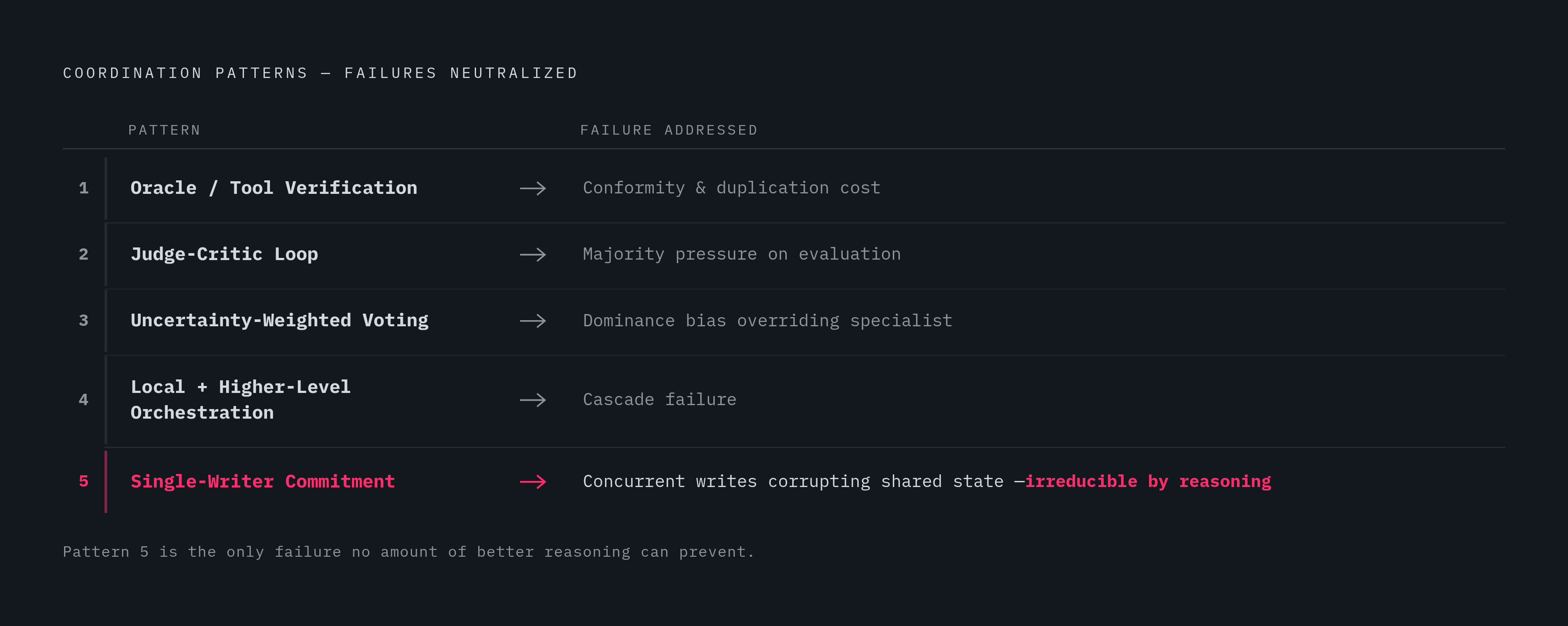
The first pattern is oracle/tool verification. When a disputed claim is verifiable, the architecture routes it to an authoritative external tool. This addresses both conformity and duplication cost, because repeating a belief is not a substitute for checking it. The limit is equally important. A tool-verification path can check only the claims that the tool can verify, leaving some of the judgments around them unchecked.
The second pattern is a Judge-Critic loop. Debater agents supply arguments, while a specialized Judge agent, typically a more capable model, evaluates their logic without generating the solution itself. Separating those roles gives evaluation a place outside the pressure to join the majority. The Judge’s task is to assess the strength of reasoning rather than produce another candidate answer and join the vote. Reasoning traces from the debate should remain in logs for debugging, even when majority voting accounts for most of the accuracy improvement.
The third pattern is uncertainty-weighted voting. Each vote receives weight based on the agent’s epistemic uncertainty about its answer given the specific inputs. An agent that flags poor input quality therefore has less say in that decision. This directly addresses dominance bias in diagnostic networks, where a general impression should not automatically override evidence from a specialist modality.
The fourth pattern is local coordination under higher-level orchestration. When an agent goes offline, local coordination re-routes tasks while the higher-level orchestrator keeps its focus on the overall goals. This division contains a disruption instead of allowing it to become a cascade across the whole workflow. It also makes the distinction between a local execution problem and a change in the overall goal explicit. The purpose is not to make every agent aware of every failure, but to keep a failure from forcing unnecessary system-wide coordination.
The fifth pattern is single-writer commitment. Agents can inspect shared state and contribute judgments in parallel, but only one commits the accepted change. This addresses concurrent writes, a failure that better reasoning alone cannot prevent. Even agents that agree can damage coordination if their writes are not controlled. Together, these patterns place verification, judgment, weighting, containment, and commitment in the architecture, where they need not depend on agents remembering to follow a conversational instruction.
Shared state and memory as the substrate consensus actually runs on
All five patterns assume that agents can access the relevant outputs and the current state of the task. LLMs do not provide that continuity by themselves when their context resets. Without an intentional memory layer, one participant can be judging a task without the state that gives the other participants’ judgments meaning. Consensus can then fail silently, because the conversation still looks coherent even though its shared basis is missing.
Each agent maintains a private namespace for session-specific short-term memory, while an orchestrator mediates a shared namespace accessible to participating agents. That separation supports collaboration without treating every intermediate assumption as common ground. Write access to the shared namespace requires locking or optimistic concurrency control. These controls bring the same rules for commitment that prevent concurrent writes elsewhere into the memory layer.
Retrieval must also keep track of which agent made each memory record. Otherwise, an assumption from one agent can enter another agent’s context as though it were independent evidence. This context bleed is the memory-layer version of sycophancy, because it weakens the independence that a later vote appears to count. Provenance is therefore part of the consensus mechanism. The system needs to distinguish access to another agent’s reasoning from uncritical adoption of it.
Communication topology further shapes which shared state agents can see. A star topology sends communication through a central coordinator, making it organized but creating a reasoning bottleneck. A mesh topology allows peer-to-peer communication, more closely mirroring expert collaboration and supporting auditable diagnostic pathways. Neither shape removes the need to control writes or preserve provenance.
This is why persistent context and scheduled execution matter to coordination. Agents that cannot carry context across sessions or act on a schedule are running stateless inference in a loop rather than maintaining the continuity these mechanisms require. Memory is the state on which consensus operates.
What the agent runtime must provide for consensus mechanisms to be operable
The runtime must enforce those coordination rules so that agents cannot get around them by writing different text. Identity and isolation give each agent a bounded execution context, making shared-state writes attributable and reversible. They also provide the enforcement layer for single-writer discipline. Without that boundary, the distinction between proposing a change and committing it remains an unenforced intention.
Observability makes failures diagnosable in a non-deterministic, parallel system. Structured logging and immutable workflow checkpoints preserve the record needed to understand how agreement formed and what followed from it. Debate traces belong within that record, but they are not enough on their own. The system also needs workspace snapshots and rollback so that a wrong committed output does not make consensus inertia permanent.
Compute and context need circuit breakers for the same reason. Token and time budgets must be enforced by the runtime. A system that can continue redundant debate without a binding limit has no dependable barrier against the coordination tax. Policy-controlled tool access supplies another boundary, allowing oracle/tool verification within enforced rules. These are controls on execution.
Alibaba Cloud Linux 4 Agentic Edition, released 2026, combines a natural-language shell, machine-readable OS skills, agent observability, and workspace snapshots. Canonical’s verified NVIDIA OpenShell snap for Ubuntu, announced June 2026, provides an isolated sandbox per agent, policy checks for files, networks and tools, resource metering, and controlled updates.
The practical consequence is that consensus cannot be bolted onto a general-purpose runtime as though it were merely another prompt feature. A missed diagnostic warning shows what is at stake when agreement suppresses the evidence that should have stopped it. Isolation, audit, rollback, budget enforcement, and structured observability make that stopping power architectural. The goal is a system in which agreement can be examined, bounded, committed safely, and undone when it is wrong.